

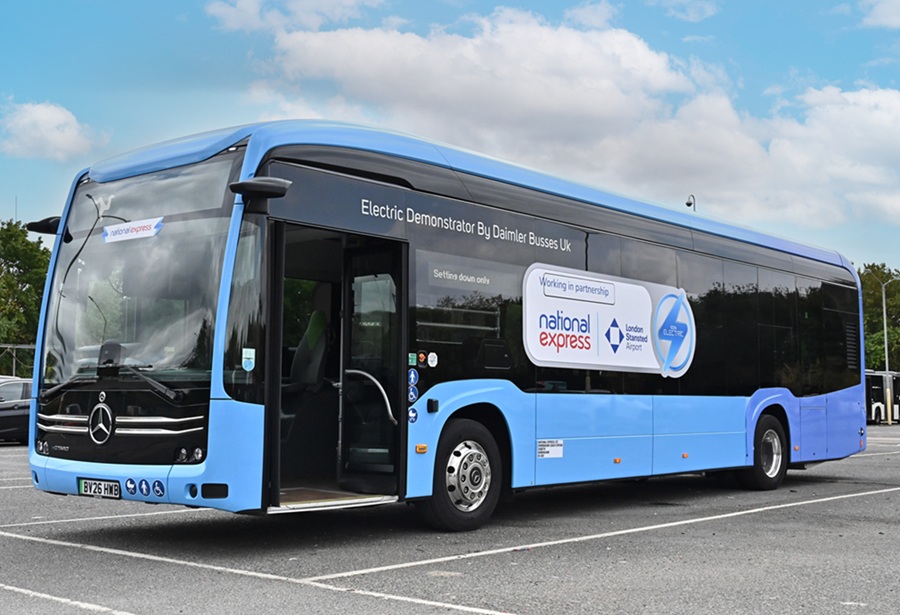
National Express trials eCitaro on Stansted Airport car park shuttle
National Express is trialling a first battery-electric bus on its Stansted Airport car park shuttle work in the form of a Mercedes-Benz eCitaro demonstrator provided by Daimler Buses UK.
The evaluation will last for a month and see the light blue vehicle temporarily displace a diesel Citaro. That existing bus covers 180 miles per day on average, providing what the operator says is “a real-world test of the eCitaro’s ability to meet the demands of a high-mileage, high-frequency airport shuttle bus while supporting Stansted Airport’s sustainability goals.”
Electricity for the eCitaro will be from renewable sources at Stansted. The trial will assess the bus’s operational performance in real-time, including energy consumption, charging requirements, and reliability and availability. Passenger feedback will also be considered.
Results from that process will be analysed by National Express and Stansted Airport, with the findings used to help inform their joint approach to the future deployment of battery-electric vehicles across the node’s transport operations. The eCitaro has already found an airport use in the UK at Bristol Airport.
Speaking about the exercise, National Express Managing Director Rafael Fernandez says: “We are committed to exploring more sustainable ways of delivering passenger transport for our airport partners, and this trial is an important step in understanding where battery-electric technology can work effectively on a high-demand service pattern.
“Over the course of the trial, we will be looking closely at the vehicle’s performance, energy use and charging requirements, alongside feedback from passengers and our operational teams. The findings will help us to understand the practical considerations for introducing battery-electric vehicles in this particular operating environment.”
London Stansted Airport Operations Director Nick Millar adds that it is pleased to support the eCitaro trial with National Express.
“The long-stay shuttle service is an ideal route to test the operational requirements of electric vehicles, and the insights gained will help to inform future decisions as we continue working towards our net-zero carbon ambitious,” says Mr Millar.

TransMach unveils new brand and website amid growth focus
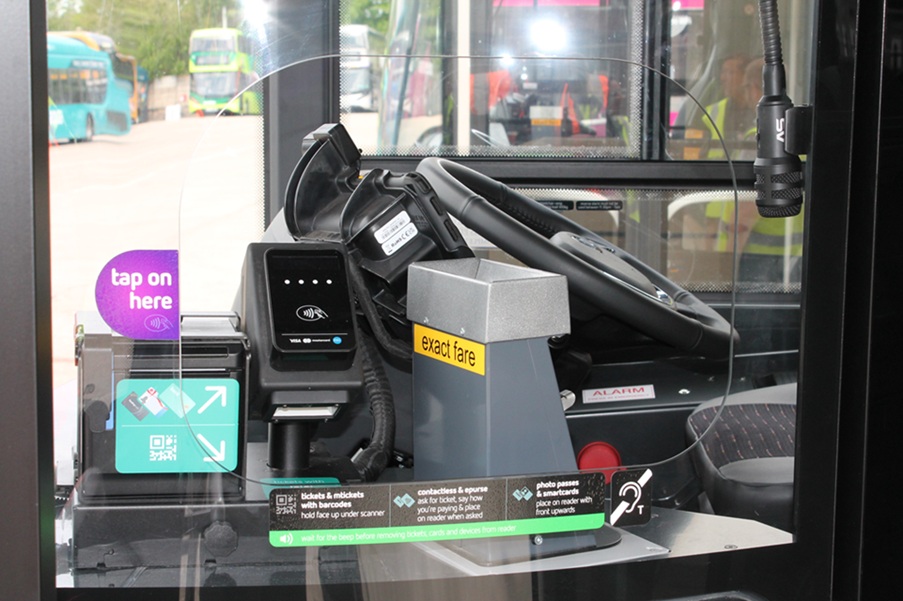
Smart ticketing technology provider TransMach has unveiled a new corporate identity and website that the supplier says sits with its ongoing growth trajectory, including planned further expansion, and celebrating its 15 years of trading.
The new website delivers a cleaner design, improved navigation, and TransMach’s full-service portfolio from contactless ticketing solutions to custom app development. TransMach is also set to roll out additional features to its 5G TM700 electronic ticket machine, which is backed up by a bespoke, cloud-based administration system, TM Cloud.
Such moves follow recent partnership wins with operators including LibertyBus, Reading Buses and Trentbarton, putting those businesses among over 300 customers in the UK and further afield.
The supplier notes how “an increasing number” of operators have switched to its 5G-enabled ticketing solutions this year, as well as benefiting from the launch of a real-time headway management system.
The latter enables effective coordination by displaying time-based distance between vehicles on the ticket machine, allowing drivers to maintain service gaps and manage passenger loadings.

Speaking about the changes, Director Minesh Vandra says: “Our refreshed brand represents a new chapter for TransMach.
"As coach and bus operators embrace digital transformation, we are committed to helping them to improve the passenger experience while achieving better and measurable operational efficiency.
“We expect to see further advancement in open- and closed-loop software for multimodal ticketing, so our new website and corporate identity reflect our focus on innovation, developing customer partnerships, and dependability.”
On the 15-year anniversary, Mr Vandra continues: “TransMach’s team remains committed to delivering value to operators without adding extra costs, as part of our standard customer agreement.
“It is a core principle for us to provide choice and hassle-free switching, with a simplified partnership structure.”

Fleet performance metrics vital amid fuel price crisis, says Centrad
The continued pressure on diesel prices is underlining a need for coach and bus operators to leverage visibility of fleet performance and to improve fuel efficiency and cut operating costs, video telematics specialist Centrad has advised.
It says that those businesses typically spend 10-15% of budgets on fuel. Ongoing conflict in the Middle East has sent that cost spiralling, with smaller operators that are unable to hedge their diesel spend particularly hard hit.
Centrad Managing Director Geoff Cross notes how there is little those businesses can do about fuel prices, but “what they can control is how efficiently [it] is being used across their own fleet.”
The supplier notes how instead of relying on isolated data points, operators can couple their telematics data to video evidence and understand not only where fuel is being consumed, but why.
Connected platforms combine artificial intelligence-powered cameras, telematics, remote system health monitoring and operational data to give “a far more complete view of fleet performance,” Centrad continues.
Bringing those technologies together gives operators greater visibility of driver behaviour, vehicle utilisation, fleet health and other factors that influence fuel efficiency. They also take into account factors such as traffic conditions, route demands, and wider operational pressures.
Mr Cross acknowledges how no operator intentionally wastes fuel, but he points out that small day-to-day efficiencies can go unnoticed. Excessive idling, harsh acceleration, speeding and poor anticipation all increase consumption. He adds that the challenge has always been gaining sufficient visibility to identify such behaviours before they become ingrained.
“As a former fleet operator of more than 30 buses, I have been there myself – that includes as a driver,” he explains. “Historically, identifying these issues requires significant manual intervention. Today, connected video telematics, combining AI-powered fleet cameras with live vehicle data, provides operators with a much clearer understanding of what is happening on the road.”
Mr Cross adds that the real value is not in collecting more data, but turning it into meaningful insight. “Connected video gives operators the context behind every event, allowing them to understand the reasons for fuel inefficient driving rather than making assumptions based on figures alone.”
Doing so changes the conversation with drivers, Centrad offers. Instead of using cameras or telematics purely to monitor, operators can leverage such connected insight to coach and support staff more effectively.
Reviewing real driving events alongside AI-generated insights enables “far more constructive conversations,” it adds. That will help drivers to understand where small behavioural changes can make significant differences to fuel use, vehicle wear, and road safety.
Continues Mr Cross: “Ultimately, the biggest savings do not come from the technology itself – they come from the behavioural changes it enables. For many operators, the focus is therefore shifting beyond just security and compliance, with connected fleet data increasingly being used to improve visibility and support better decision-making across the business.
“By providing greater insight into fuel-wasting habits, operators can address those behaviours through targeted, evidence-based coaching. Even small changes in driving style can deliver significant annual savings across large fleets, while also helping to improve vehicle efficiency and reduce unnecessary wear and tear.”