Agreement for Swvl to purchase Zeelo is terminated
In an unexpected development, the agreement for global transit technology business Swvl to acquire London-based smart coach and bus travel platform Zeelo has been terminated.
The transaction – described at the outset by Swvl as “a definitive agreement” – was announced on 28 April with an expected conclusion date of 24 May. However, on 29 July, Zeelo instead said that while all pre-completion obligations had been met, financial market volatility has since led the two parties to mutually agree to terminate the deal.
Zeelo adds that it will now continue to focus on a profitable increase of business in markets including the UK, South Africa and the United States to provide “sustainable rides” for commuters and students. Zeelo has seen 1,000% growth since the start of 2020 and currently transports over 150,000 passenger each month by serving over 150 clients, it says.
When the proposed purchase by Swvl was announced, Zeelo Co-Founder and CEO Sam Ryan told its operator partners that business would continue as usual under the new owner.
Swvl added concurrently that the two businesses were “in alignment,” including the work underway by Zeelo to ensure that only zero-emission vehicles are used on its behalf in developed markets by 2030.
On 30 May, Dubai-headquartered Swvl announced “portfolio optimisation” plans to “accelerate its path to profitability” and become cash flow positive in 2023. Part of that work is to reduce the business’s costs, with Swvl's headcount to be reduced by approximately 32%.
Equipmake sends battery-electric bus to Buenos Aires
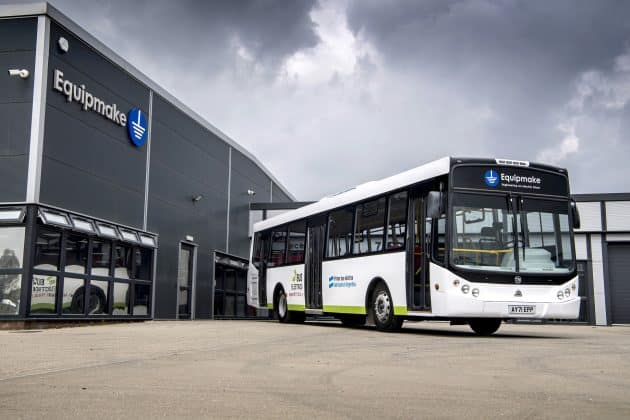
Equipmake has dispatched a single-deck battery-electric bus with its modular driveline to Buenos Aires. It follows the completion of testing of the Agrale MT17.0LE vehicle in the UK and will see the commencement of in-service trials in the Argentine capital.
Within the bus is the same Equipmake drivetrain that the OEM will use in the Jewel E double-decker for the UK. That powertrain can also be used on a repower basis in existing buses, as debuted in a Volvo B5LH earlier in 2022.
Equipmake has worked with Brazilian bus manufacturer Agrale and Argentinian bodybuilder Todo Bus on the bus for Argentina. It has been developed as part of an Advanced Propulsion Centre (APC)-funded cost effective low entry Bus project. The Snetterton firm led its two partners on the work over three years with an objective to deliver a cost-effective battery-electric bus to suit South American conditions.
318kW/h of energy storage is included in the MT17.0LE via lithium-ion batteries to deliver an estimated range of 150 miles. Equipmake’s HTM 3500 motor is used. Thousands of miles in and around Norfolk and on proving grounds have been completed as part of the UK testing phase. The ultimate objective is for mass production to begin in Buenos Aires by Agrale and Todo Bus using licenced Equipmake technology.
Says Equipmake Managing Director Ian Foley: “I am delighted that, following the completion of final testing here in Norfolk, the Agrale MT17.0LE now begins its journey to Buenos Aires for in service trials.

“Throughout this innovative APC-funded project, we have worked closely with Agrale and Todo Bus along with other key partners. The result is a state-of-the-art yet cost-effective bus.
“We are now looking forward to the start of the trial. The potential for this new vehicle is huge. Buenos Aires has around 16,000 buses on its streets – roughly twice the size of London’s fleet.
"There is no doubt that electric buses can play a significant role in helping Argentina’s capital hit its 2050 net zero objective.”
Equipmake adds that its Jewel E demonstrator, which is bodied by Beulas, will now begin in-service trials with Go-Ahead London “in the coming months.”
Totalkare: Diversification and expansion at its heart
Totalkare has grown in recent years from being a supplier of vehicle lifts to one that is now active across multiple types of workshop equipment. That, combined with an ongoing strategy for growth, has seen the supplier treble its product sales in value terms and double its service-related turnover. 20 mobile technicians are now active in the latter area of its business and it also has a dedicated installation team.
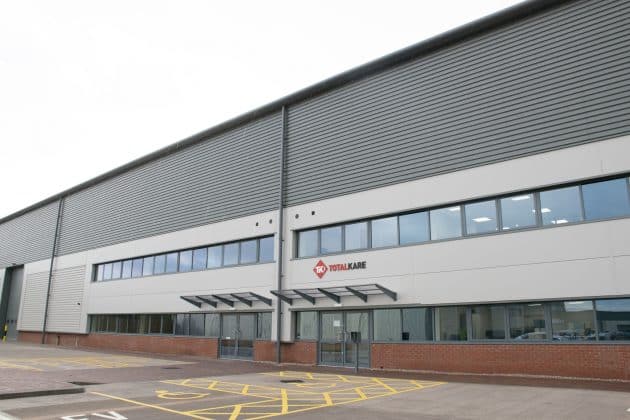
As the Totalkare range has grown to include brake and headlight testing equipment, pits, workshop furniture and others – and with more to come – so has a need for space. Totalkare now calls a combined office, workshop and warehouse building in Kingswinford home, and it is in the process of adding an additional floor of office accommodation.
The supplier lists quality service and products, a growing equipment line-up and strong relationships among reasons for its expansion. Changes within the coach and bus maintenance field have also been influential. The government’s super-deduction scheme to encourage investment has helped further, CEO David Hall notes.
“Our message has become that while we are still active across the vehicle lifting sphere, lifts are not all we do,” he continues. “That has taken effect and we are now viewed more as a workshop equipment supplier.”
Putting a brake on testing times with new range
Coach and bus businesses have shown strong interest in brake testing equipment, David notes. He refers to a brake tester as “a compliance product” in view of Traffic Commissioners’ placing of great emphasis on regular such testing, and the severity of regulatory action against an O-Licence that may follow if it is not heeded.
“We have seen lots of demand for brake testing products,” he continues. “Operators previously often used third parties, but it can be difficult to obtain appointments.” In-house brake testing “can also be a revenue opportunity.”

Most coach and bus operators that have purchased brake testers from Totalkare have fleets of 20-50 vehicles.
Besides giving surety of availability, an in-house tester reduces planned vehicle downtime, costs and the business’s carbon footprint.
Wheels and tyres are a further area where Totalkare sees scope to grow. Wheel alignment is key to fuel efficiency and is an area where the supplier is already active. Mounting and dismounting tyres could become an area of wider interest owing to the health and safety implications of doing so manually. Totalkare now has products that carry out those tasks both automatically and much faster than doing so by hand.
Lifting: All bases still covered by Totalkare
Although Totalkare has expanded into new markets, its core vehicle lift range remains strong. In the coach and bus sector, column lifts are the favoured solution. Totalkare meets that requirement with its T8 range.
The T8AC runs directly from a three-phase plug-in supply, while the T8DC is battery powered and thus cable-free. Typically, around 40 sets of four columns are in stock at Kingswinford. Older models are present for repair or refurbishment or having been taken in part-exchange.
Something that Totalkare is keen to stress is the importance of using six columns for tri-axle vehicles. Using four and leaving the tag axle unsupported sees the counterweight effect of the heavy driveline result in a major loading imbalance. Besides accelerating wear on the columns supporting the drive wheels, such a practice can also damage vehicle airbags on that axle and is something that should be avoided.
Lifting platforms retain a following in coach and bus, and Totalkare has issued multiple quotes for them to the sector this year, including for a 13m galvanised example. An attraction of a platform lift is the ease and speed of its operation, while it is also easily moved to new premises if needed. Sales Director Adam Bowser describes it as “a pit in the sky.” An in-ground lift, which uses hydraulic columns, is due to market soon.
Totalkare now a growing and diversifying business
In line with its diversification, David observes that Totalkare’s market proposition is now about offering “a full package” of well-supported workshop equipment. The business has paid close attention to service, he continues; in addition to field engineers, the parts supply process has been overhauled to ensure that it is as efficient as possible. That includes automatic demand planning to ensure that items are available.

Another move to strengthen service has been the appointment of two product specialists.
They work with lifting and testing, respectively, are involved with all aspects of the sale and operation process for their respective equipment streams, and are likely to be joined by others in the same role that will champion different areas of the business.
“We will continue to invest money to ensure that we are ready for the future,” David continues. “Our priority is to make sure that customers are happy with products and service. A lot of that comes through doing simple things: Answering the phone when it rings, having parts in stock and turning up when we say we will.”
A further example of Totalkare’s ‘full service’ approach is its project management capability when civil engineering work is required for equipment installation, while it has a strong and adaptable funding offer that includes contract hire and finance in addition to traditional purchase.
A service package can be incorporated into a monthly charge, of which repair and maintenance is popular among coach and bus operators. “Our one-stop approach is bringing us new customers and it is also allowing us to do more business with those that we have already,” David concludes.