

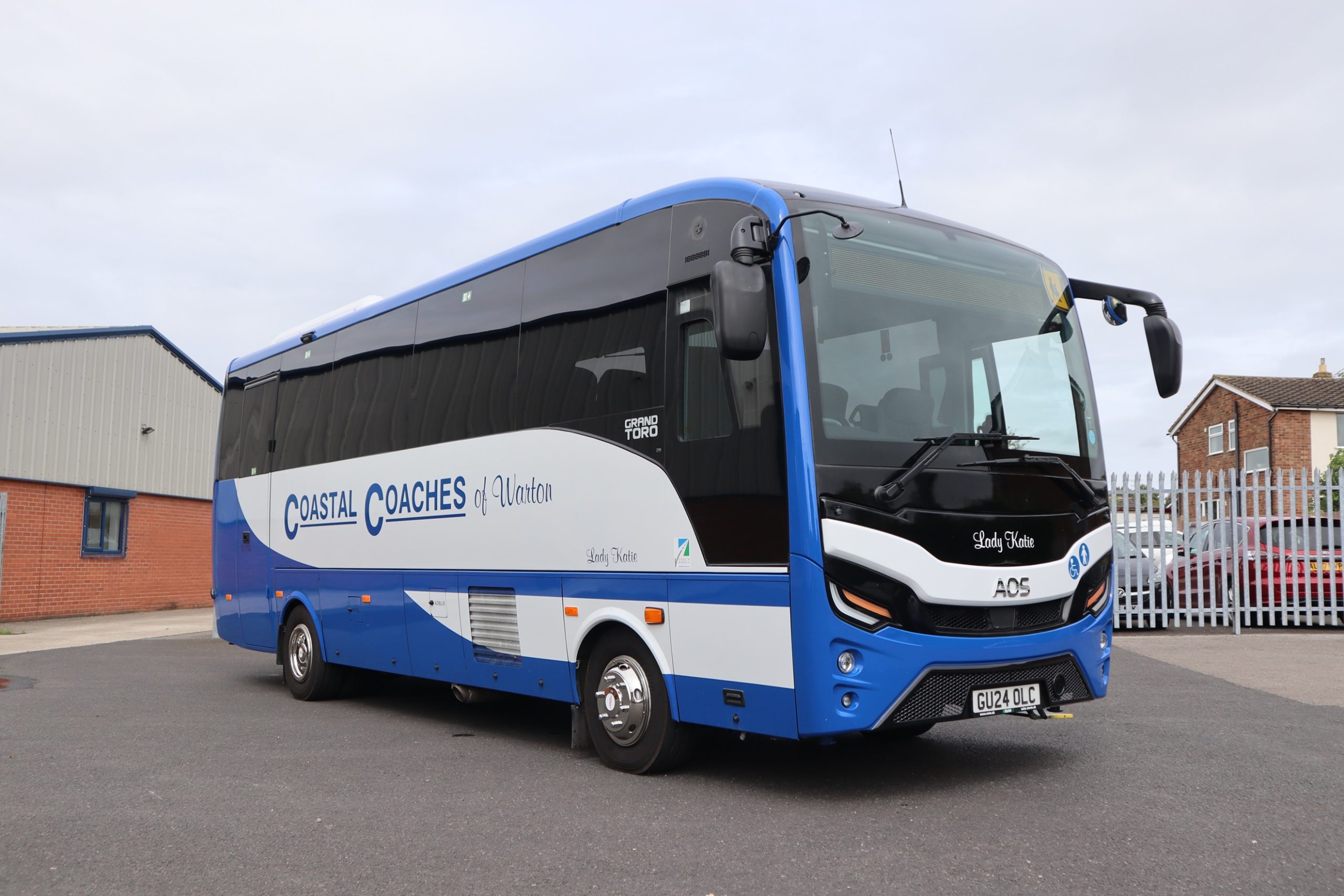
AOS Grand Toro ticks PSVAR midicoach box for Coastal Coaches
Evolution of the midicoach market over the past decade has led to growing prominence of rear-engined models. But driveline at the front remains the layout for several popular products in that field, including the AOS Grand Toro, which is supplied by EVM and built in Turkey by Anadolu Isuzu.
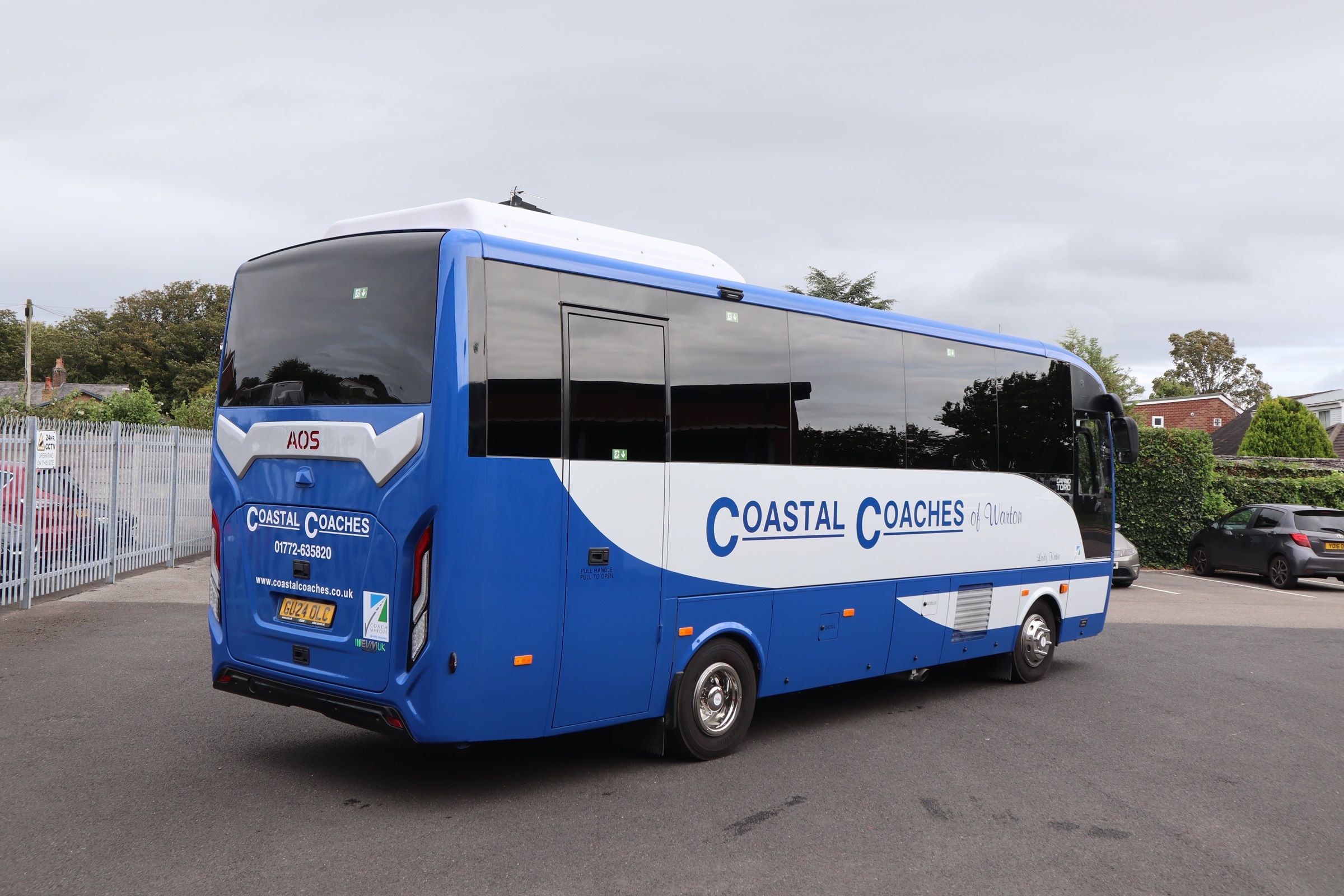
Among buyers is Coastal Coaches of Warton in Lancashire. It has two, both of which are PSVAR compliant; the initial example was the first Grand Toro completed in accessible format. Alongside the AOS midis, Coastal recently received a coachbuilt Grand Tourer minicoach from EVM, mounted on a Mercedes-Benz Sprinter underframe.
That is significant investment for a fleet of 16, which is now entirely coach-based after local bus service contracts ended. The EVM-sourced products sit alongside a core of Mercedes-Benz Tourismos as the large coach of choice, and vehicles from UNVI that include several Compa T-bodied Iveco Dailys and Sprinter-based products.
Coastal Coaches has long worked closely with UNVI. The operator’s Managing Director Bill Holder notes that purchase of other mid-sized products does not mean that collaboration has ended; Coastal recently bought an UNVI minicoach and another is on order. Meanwhile, the adjacent CoachTec authorised agent still holds £300,000 of UNVI parts, although vehicle sales are now led by Whitburn-based Coachtraders.
AOS midicoach 'gamble' already paying off for operator
The Grand Toros have succeeded two UNVI Voyager-bodied Mercedes-Benz Ategos. “We could see the need to move more towards PSVAR compliance in midis, so had a good look around,” says Bill. “For the price, the AOS was a good product and a good fit for our fleet.”
As factory-finished PSVAR examples, the Coastal Coaches twins each have a D’Hollandia lift. It is mounted ahead of the drive axle. To conserve space when stowed, the main part of that unit is in two nested pieces. Upon extending the lift, one section slides out to give a full-size platform. Maximum loading is 350kg.
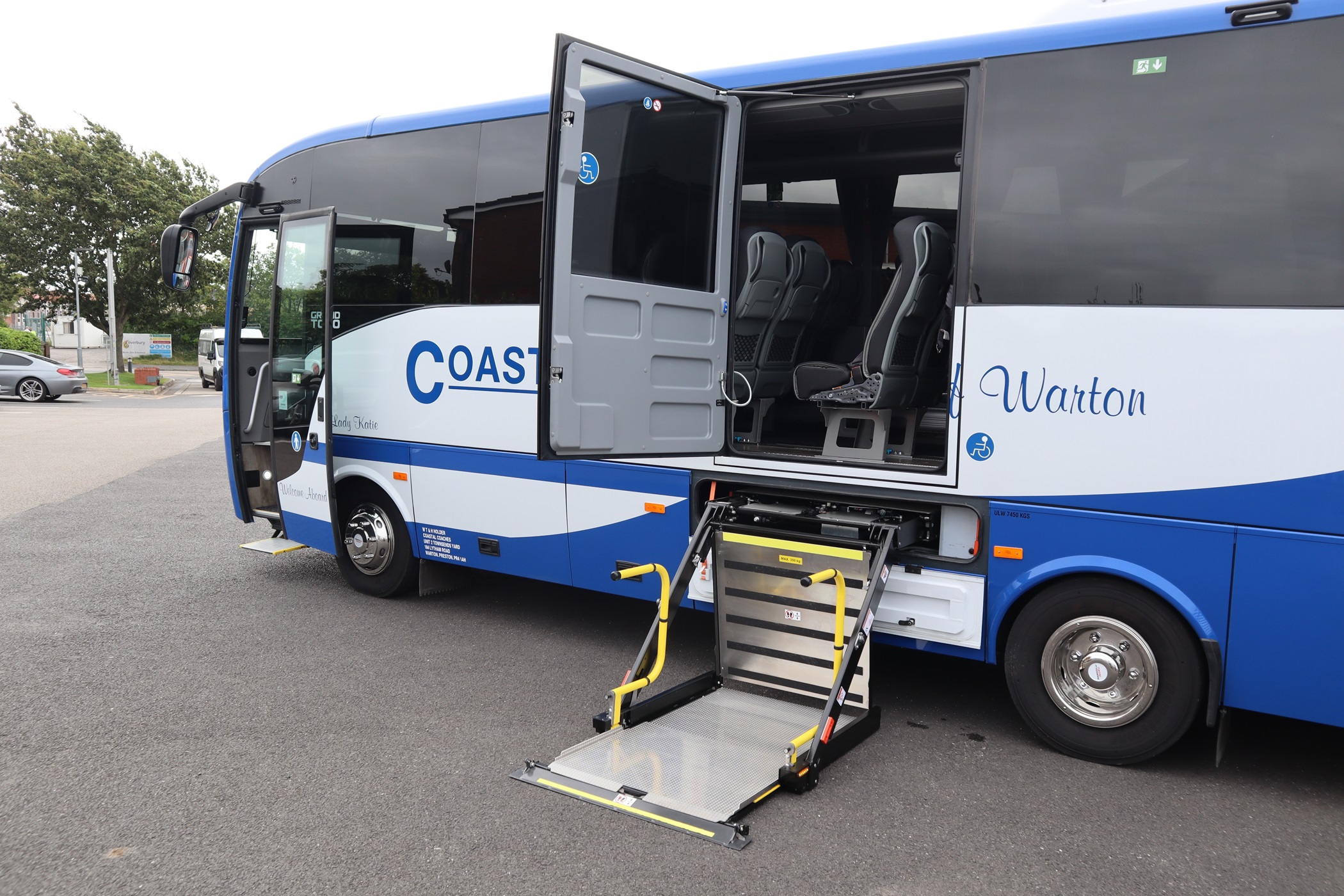
Within the saloon is an area with four tracking rails and seats on quick-release legs. Securement devices for wheelchair users are from Q’Straint.
Each of the Grand Toros is finished in Coastal’s blue and white livery, which suits them. While Bill acknowledges that going with a manufacturer relatively new to the UK could be a risk, he counters that by pointing to EVM’s established support infrastructure.
“The Grand Toros are a shift from the norm for us and we have taken something of a gamble. We were pleasantly surprised upon test driving one and are confident in Turkish-built vehicles after good experience with our Tourismos. The Cummins and Allison driveline gives us confidence. Based on what I wanted, what I paid, and what I got, I believe these vehicles are a safe bet.”
AOS Grand Toro meets Coastal's multipurpose requirement
While the Grand Toro has sometimes been seen as more of a local contract and private hire vehicle, Coastal Coaches’ policy is that fleet members are multipurpose.
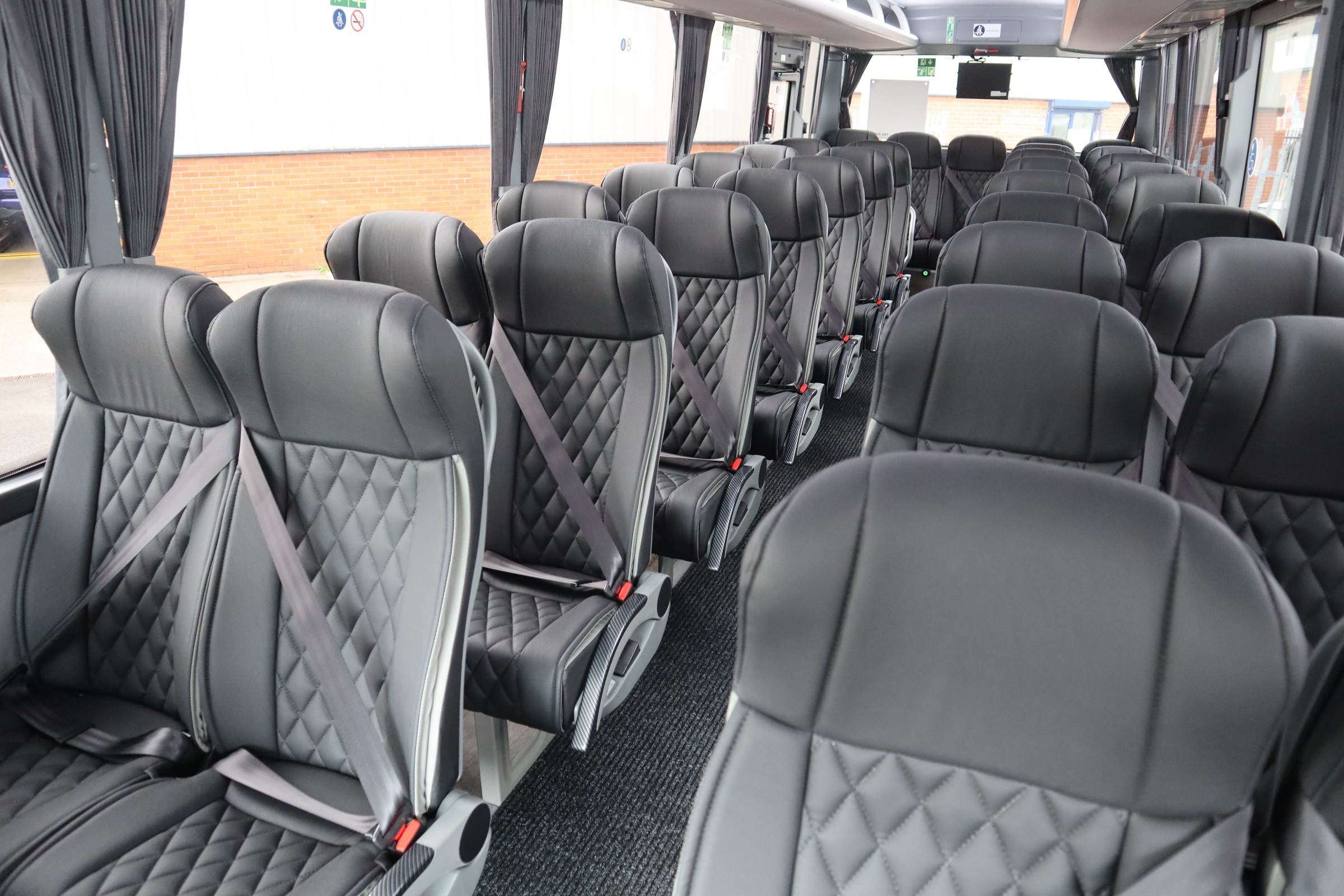
Because of that, and the attractively finished interior, the operator would not hesitate to send one on tour when appropriate. They also suit rail replacement; Bill observes that some rural stations are difficult to reach with large coaches. “We like the model’s compact nature,” he adds, which is helped by the engine and gearbox being above the set-back front axle.
Coastal Coaches’ approach is built around offering a quality service, Bill continues. Do that and customers will book despite cheaper competitors, he believes, but in addition to a focus on service, vehicles are part of the strategy. Appearance of both fleet and drivers is key, along with personality for the latter. Cleanliness and comfort are another priority. Coastal has a dedicated cleaner who works four days per week to reduce that burden on drivers.
Modern fleet brings operational advantages
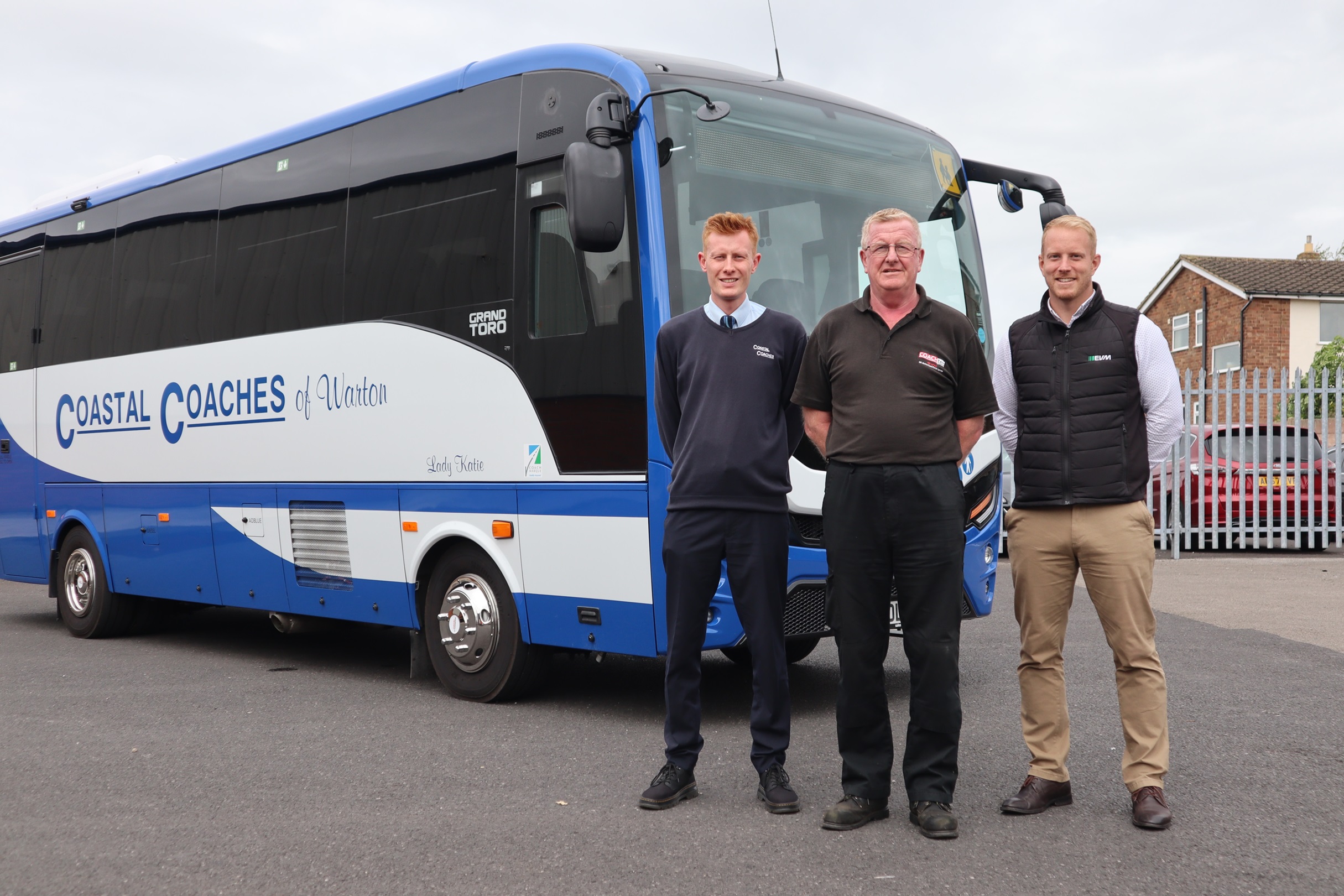
Bill adds that modern vehicles bring various benefits. “A fleet that is clean and new is noticed,” he explains. The operator also believes that an up-to-date fleet is beneficial in attracting drivers, although there is a lot more to staff retention than what they drive. Making an employer somewhere that people want to work is the overriding factor.
Parts availability and warranty coverage are a further part of Coastal’s fleet policy, while the government’s approach to annual investment allowance and full expensing are also seen as increasingly favourable to capital expenditure.
“Key is a vehicle’s residual value after five years, not just what I paid for it in the first place,” Bill continues, noting that a strong second-hand market – as now – helps new purchases.
“It is the difference between the two figures that is most important. My approach has never been to look solely at the headline price, but at the cost of owning the coach over a certain period, although in the post-2020 world, it is still imperative to keep a close eye on every outgoing.”
The Grand Toro pair fit into a strategy of buying what is needed. The model’s 35 seats can be had in larger midicoach models, but in addition to private hire, rail replacement and tours as needed, each fleet member is required to do home-to-school work when called upon. The AOS model also suits corporate duties, the operator finds.
The approach to PSVAR: ‘Compliance, not complaint’
PSVAR compliance specified on the Grand Toro pair by Coastal Coaches recognises the coach industry’s accessibility shift, Bill continues. While work on the review of PSVAR continues, he believes that the sector opposing existing or changed requirements is futile. Compliance, not complaint, is his mantra.
The same is true for accessible information regulations and their impact on rail replacement. The operator’s knowledge in that field is led by Bill’s son Thomas, whose history with train operating companies and rail replacement providers can be traced to when he was at university in Manchester and would work controller shifts during planned blockades.
“We will not change legislation, and it is easy to waste time complaining and finding reasons not to comply,” Bill continues. Nevertheless, use of lifts fitted to Coastal Coaches vehicles is rare.
But in a fleet where residual values are an important part of purchasing, where vehicles often have a subsequent owner’s name on them well before release, and where a tour one day may be followed by home-to-school or rail replacement the next, versatility is key – and in PSVAR compliant form, the Grand Toro has that box ticked.
Grand Toro continues to deliver for EVM
EVM has delivered three PSVAR compliant Grand Toros so far. The two supplied to Coastal Coaches are complemented by one with a buyer in Scotland.
The dealership has a regular flow of Grand Toro arrivals, and manufacturer of the AOS-branded vehicles Anadolu Isuzu is largely unaffected by the lead time difficulties seen by some other builders, says EVM Area Sales Manager Matt Thompson.
Most Grand Toros arriving here are as a minimum prepared for PSVAR to allow for easy full conversion later. If required, EVM can arrange for them to be completed and fully compliant before delivery. In that position, a PLS lift and Hanover destination displays would be fitted in the UK.
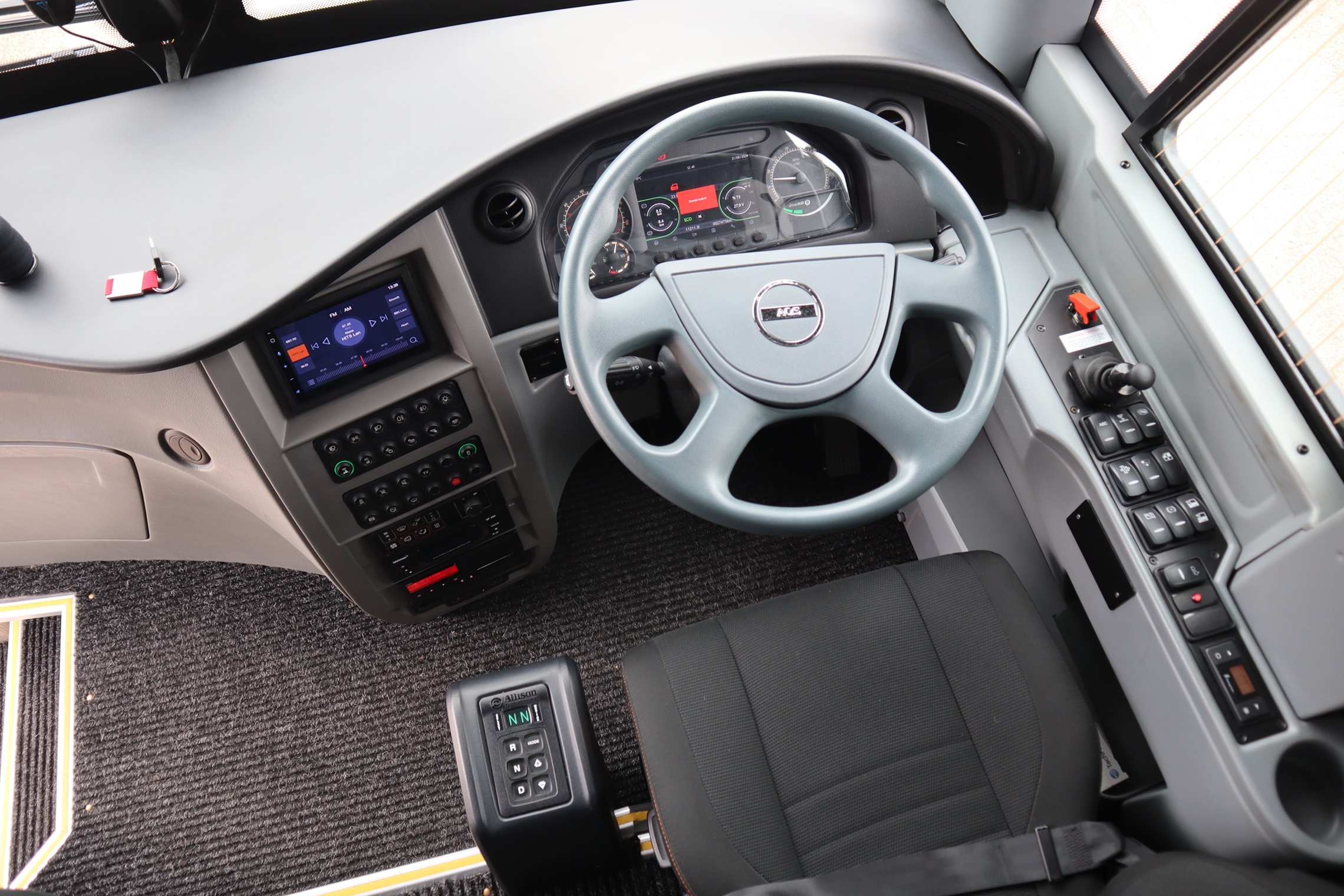
The Grand Toro continues to account for the bulk of AOS midicoach products sold by EVM, but the larger Visigo is also present. It has a Cummins B6.7 six-cylinder engine and ZF EcoLife gearbox compared to the Grand Toro’s four-cylinder B4.5 and Allison unit, and thus sits in part of the market with very similar competing products.
Nevertheless, the Grand Toro has filled a niche and is viewed by customer Coastal Coaches as a versatile and refined vehicle. Bill does not rule out taking a third, should the need and work be there.

Aquarius IT adds welfare and safety check capability to its app
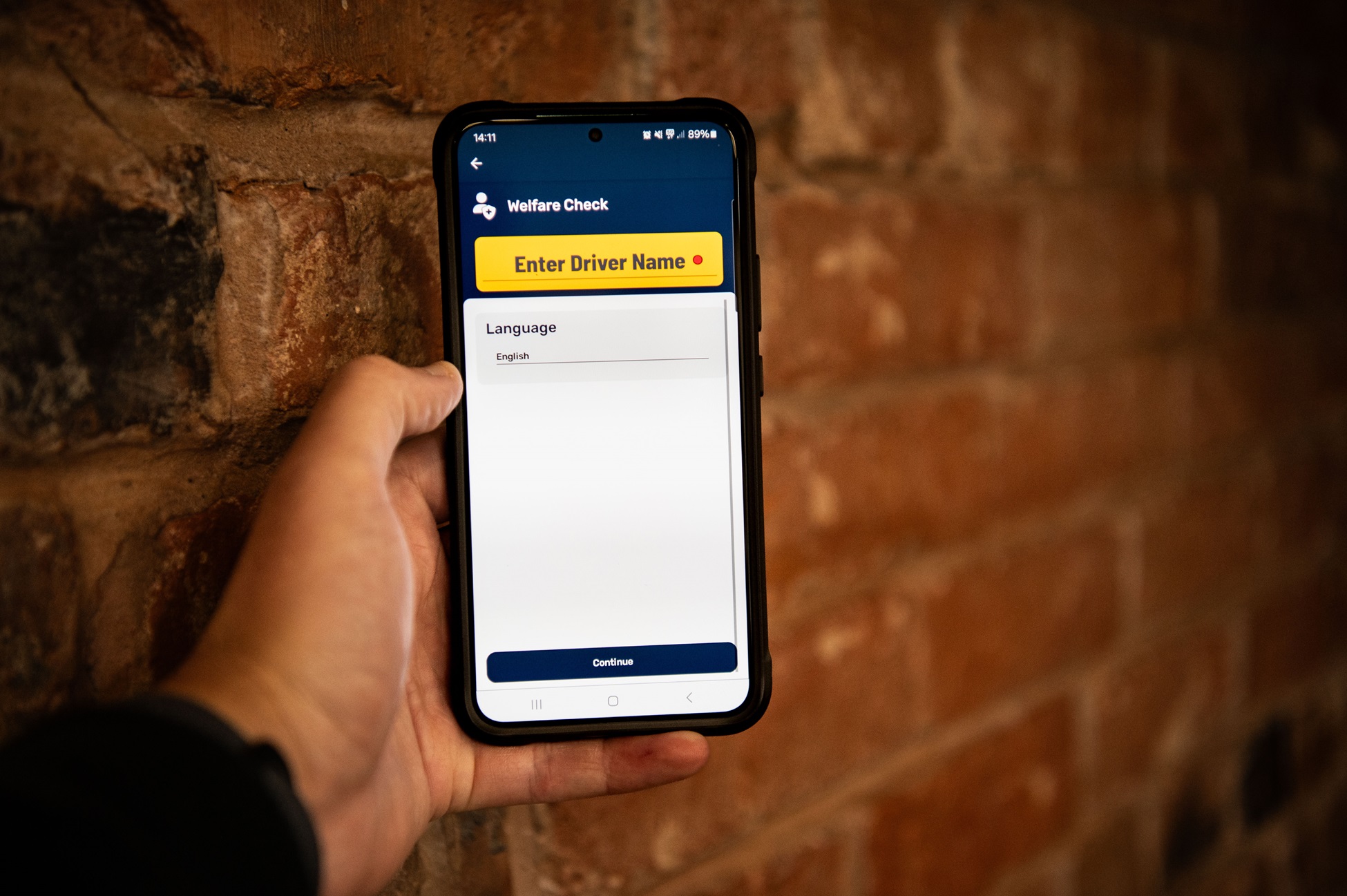
Aquarius IT has added a customisable driver welfare and safety check into its Aquarius app. It says that provides a simple tool for line managers to assess and record driver information during safety spot checks to make sure that staff are fit, healthy, and safe to drive and work.
In a similar manner to all other ‘check’ modules in the Aquarius app, the welfare and safety check has a pre-set list that can be customised or added to based on the customer’s needs.
Those can range from recording the results of routine breathalyser and drug tests, to spot checking the cab area so as to ensure that there are no obvious wellbeing issues and that everything is safe and comfortable for the driver.
Written and photographic checks could also include making sure that mobile phone policies are being adhered to and that the right PPE has been issued and is being worn.
Taking such items seriously not only considers drivers’ health, safety and welfare but also factors in protection of an operator and its reputation, Aquarius says.
Speaking about the new module, Aquarius IT Managing Director Mark Johnston says that the supplier has been in conversation with several customers on the welfare and safety check subject for some time.
“We know that there are many companies that already carry out these spot checks on paper as part of their enhanced duty of care policies and are looking for an easier way to capture the information digitally for analysis, traceability, and due diligence,” he continues.
“By prioritising the welfare of drivers, they have found that this not only benefits the individual personally, but also enhances safety and overall productivity.
“The Aquarius app has been purposely designed to aid this process. Line managers responsible for these in-person spot checks will have a company-approved checklist on their phone or tablet, which will make the whole process easier to manage.”
Mr Johnston adds that creation of a digital audit trail allows information to be analysed and investigated further “for even greater back-office insight.” Reminders can be scheduled if any driver follow-ups are needed.
“This will all enable employers to be better informed about their workforces, so that the most effective health, safety and welfare measures can be put in place proactively for the benefit of everyone involved," he concludes.
Solar-powered real-time Journeo displays for Scottish Borders
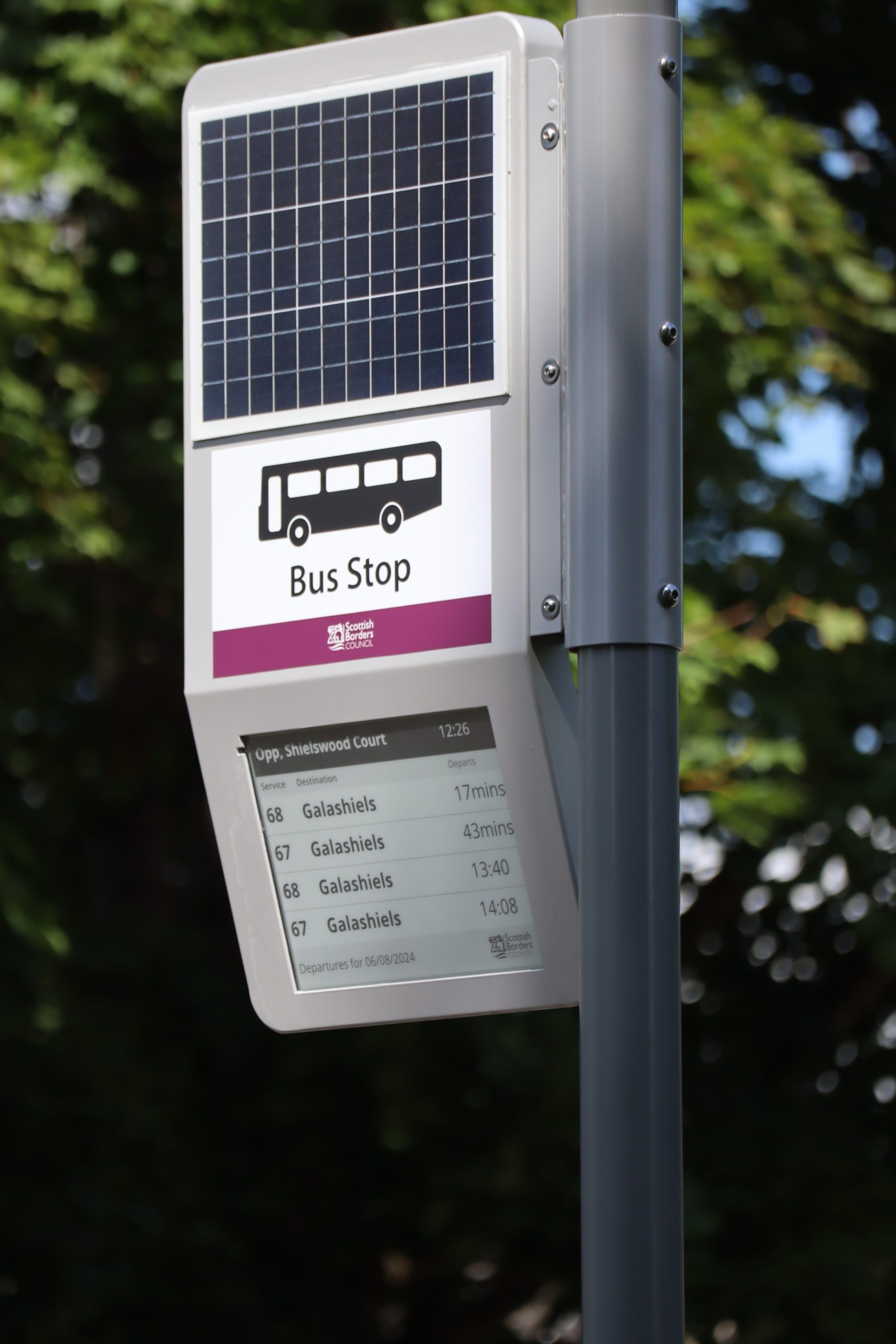
15 Journeo real-time bus stop displays that are solar powered have been installed in remote communities in the Scottish Borders Council area.
They utilise Journeo’s e-paper technology and have significantly reduced cost of installation compared to cabled units, the supplier notes. That saving has come via the lack of civils work required and removal of ongoing costs of grid electricity to power them.
Maintenance requirements of the displays are “minimal” and power draw is low, which Journeo says is important in order to maintain functionality during periods of low ambient sunlight.
Scottish Borders Council has been a client of Journeo for over five years. The latest project is being funded by Scotland’s Community Bus Fund.
The displays form part of the local authority’s long-term strategy to improve the bus passenger experience by providing accurate and timely travel information in rural locations and increasing the number of real-time displays at stops.
Speaking about the work, Scottish Borders Council Localities' Transport Officer Dan Cathcart says: “These innovative displays from Journeo have extremely low power and data requirements. They can be easily fitted to existing poles, and are quickly up and running.
“We do not have to close roads or fund roadworks to lay new power cables. But the big winners are our customers in rural communities, where they will benefit from more consistent information about their bus services.”
Adds Journeo Group Sales Manager Ted Beatson: “The most costly and time-consuming challenge for a local transport authority rolling out real-time information is the need for power infrastructure to be in place.
“If it is not, it is extremely costly and disruptive to carry out the necessary works. Our e-paper displays are ideal in situations where complicated and costly works need to be avoided. Using our self-sustained units, which fit quickly to existing poles, need no power connection, and are proven to work in the region, is a win-win for the council and the community.”