
CEN Group base in North Wales set to support customers there
Safety and surveillance solutions specialist for fleet operators CEN Group, which includes the Centrad brand, has purchased premises in Llanfair as part of its work to continue supporting customers in North Wales.
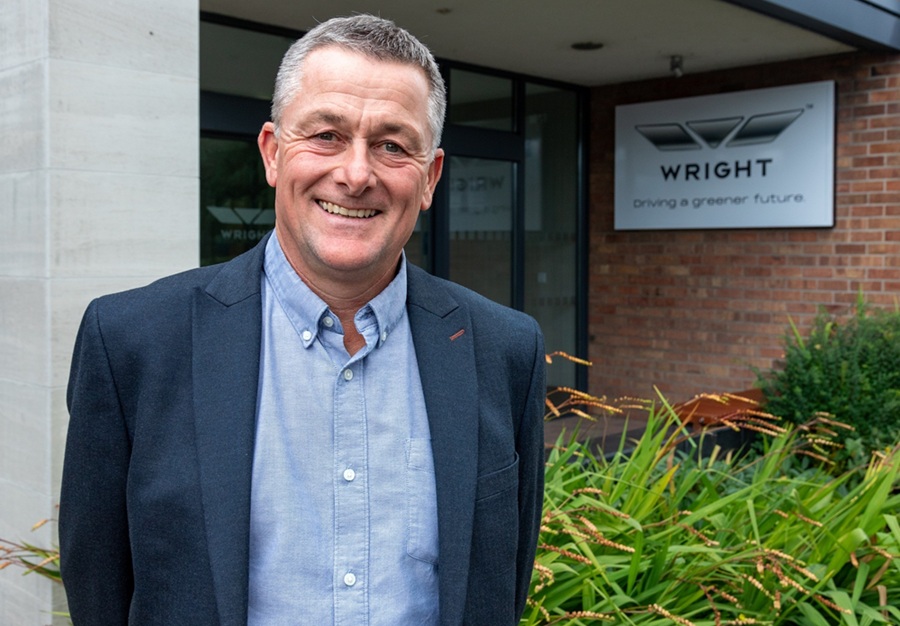
The Old Llanfair Stores is currently empty but Managing Director Geoff Cross (pictured) says it “is the perfect site to establish a dynamic local hub that will serve both the community and our growing customer base” in the region.
Mr Cross adds that CEN Group plans a comprehensive refurbishment and fit out for the premises to create a modern and flexible workspace while respecting the unique character and heritage of the area. “The project reflects our long-term commitment to investing in North Wales and driving sustainable economic growth,” he continues.
The supplier adds that the Gwynedd site will strengthen its ability to provide high-quality services and rapid response times to users of its products in North Wales while also creating new jobs.
Purchase of the Llanfair building is part of CEN Group’s ambitious growth plans that see it on track to double revenues to £10 million within the next 18 months. The North Wales site will be supported by CEN’s head office in Staffordshire along with its international bases in Dubai and the Philippines.
The supplier’s solutions are focused on CCTV, video telematics and artificial intelligence driver monitoring technology. It has a number of customers in North Wales, including coach operator Llew Jones, which won the Best Use of Technology – Coach Operator category at the 2025 routeone Awards.

Reading Buses selects TransMach as ticket machine provider
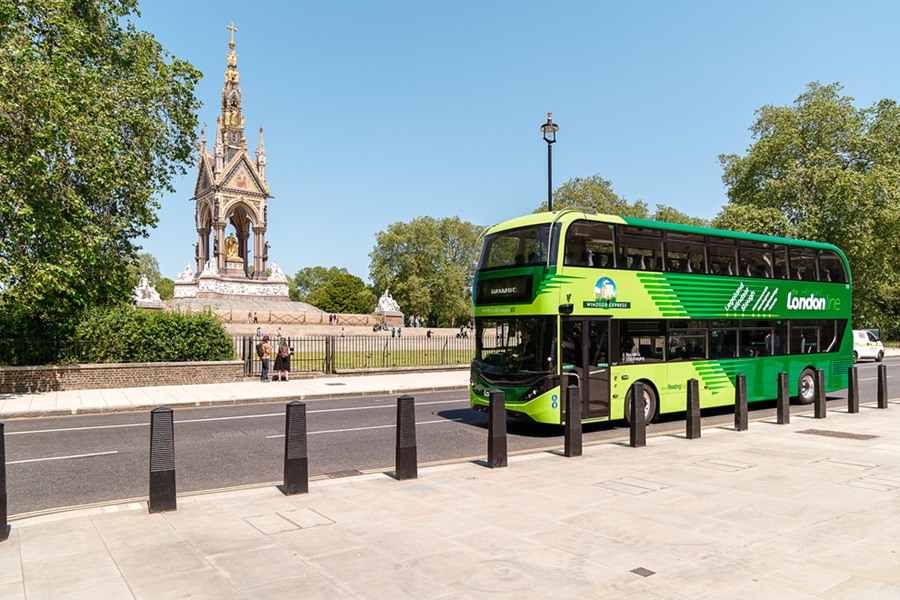
Reading Buses and its subsidiaries will roll out TransMach ticket machines across 285 buses from mid-November after what the operator describes as an extensive, year-long tendering process.
That exercise considered the type of technology deployed, payment speeds, software flexibility, integration with other suppliers’ platforms, acceptance of contactless, tap-on, tap-off capping, barcodes and ITSO smartcards, delivery of Bus Open Data Service (BODS) compliant punctuality data and reporting, the municipal operator says.
It adds that key from launch of the first units on 16 November is integration with Freeway Fleet Systems software for direct electronic recording of defects.
Data will also flow from the machines to the Velociti Systems suite and the CitySwift platform for analysis, Passenger for app and website use, Littlepay for payment processing, r2p for next stop announcements, multiple SIRI feeds for real-time systems, and BODS.
An agreement with Reading Buses represents TransMach’s largest order to data. The processing of smartcards will use new fourth-generation Indexed Sequential Access Methods. The new machines and platform come with various other features, including:
-
- Improved defect checks and messaging system
- Faster payment processing
- A panic button
- Separate readers for smartcards/contactless payment and for QR codes
- An Android tablet with eight-inch landscape screen and 5G compatibility
- A supervisor mobile app with live tracking and messaging.
On the separate readers for smartcards/contactless payment cards and QR codes, Reading Buses says that will remove an issue that can be created when cards are kept behind mobile phones and interfere with the scanner. It will also allow future development for acceptance of electronic PlusBus tickets.
Speaking about the agreement, Reading Buses CEO Robert Williams says: “We were really impressed by the way that TransMach was able to quickly develop and adapt to meet our requirements.
“The ticket machine has become so central to so many aspects of our operation that making a change is not a simple task. All credit goes to our team, who have been working really hard behind the scenes to ensure that our customers and employees will see a seamless transition.”
Adds TransMach Director Minesh Vandra: “We are delighted to be working in partnership with Reading Buses on this major ticketing upgrade project.
“TransMach’s latest generation 5G electronic ticket machines and cloud-based management support will provide the operator and its subsidiary companies with a range of enhancements, including faster payment processing and boarding times, increased passenger convenience, and more seamless automated administration.
“We are very proud to welcome Reading Buses into the TransMach family and look forward to developing this relationship in 2026 and beyond.” Rollout of the new machines will be complete by Christmas, the operator says.
Coach products are a growing focus area for a busy Wrightbus
Entry to the coach segment by Wrightbus is positioned as a natural extension of its bus building activity, and for now the thinking around products captures two lines: the diesel-fuelled Contour, built by King Long in China, and a platform that will be designed and manufactured in-house and which will debut as a maximum-dimensions double-deck using hydrogen fuel cell-electric propulsion.
Much about the Contour is already known, with that Cummins-powered vehicle having broken cover earlier in 2025. From there things moved quickly, and development of the Contour’s specification is shown in a second demonstrator.
That coach is left-hand drive and bound for Germany, where Wrightbus is making strong headway with the supply of hydrogen buses. Moreover, 39 Contours have been sold to Bus Éireann for use as school coaches in Ireland.
Head of Coach Sales Dave Porter advises how the hydrogen coach project has accelerated recently. The first vehicle is expected to be completed within the coming 18 months, and early consultation of potential buyers has generated a positive response.
In that opening form, the 15m long, 4.2m high double-deck is aimed squarely at scheduled service operation to start with, but there is scope to build below those parameters later on the modular platform.
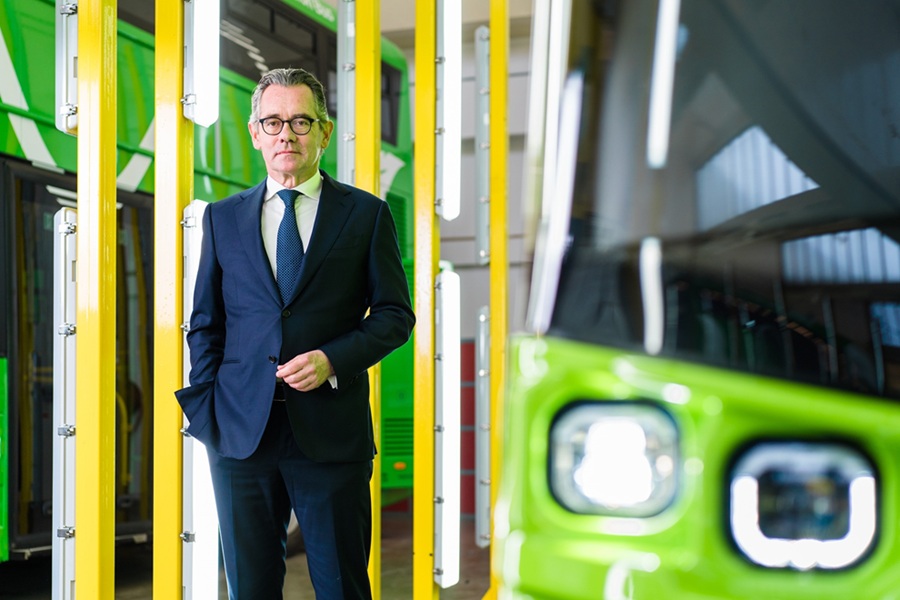
Wrightbus CEO Jean-Marc Gales adds that a diesel variant is likely to follow in 2027. Renderings of the initial double-deck concept show that Wrightbus is looking to a striking visual appearance for its newcomer.
Contour gives Wrightbus good coach starting point
The Contour is built at 12.2m on two axles. Lead time from order to delivery is between six and eight months, although Wrightbus does not intend to hold the product in stock; all will be built by King Long to customer order. Sister business AllServiceOne will support Wrightbus coach products. That involves parts supply and delivery of training as an extension of its work with bus operators.
Exact pricing of the Contour is not disclosed, but Dave says it will be competitive. The left-hand drive demonstrator gives an excellent idea of what customers in the UK and Ireland can expect, with the Cummins X11 engine rated at 400bhp driving through a ZF EcoLife automatic gearbox and turning at 1,250rpm at 62mph.
As shown, it has 51 Fainsa Gala seats in a cream and blue configuration and a centre sunken toilet, although if that is deleted, capacity increases to 55. Compliance with the PSV Accessible Information Regulations can be specified, while for PSVAR the model comes in fully compliant format or ready for later conversion alongside a variant without accessibility equipment.
Specification elements typical of a coach in its class are fitted, including USB charging points, wood-effect flooring, twin monitors and convector heaters. Legroom is variable, particularly on the continental nearside behind the toilet. Rear-view mirrors are installed on the demonstrator, but a camera monitoring system is available and will be used on the Bus Éireann vehicles.
The cab has a digital dash binnacle, and the Contour fully complies with the General Safety Regulation to suit plans to sell it in the EU. Dave notes how care has gone into the underfloor luggage area, which is also treated with wood-effect flooring. Powered bay doors are fitted along with a coolant pre-heater. There is good space around the engine, while the radiator has seven small electrically powered fans.

Contour demonstrations with operators to start in 2026
“Wrightbus has taken this product off the King Long shelf and then worked closely with the builder to improve it,” Dave explains. Wrightbus staff are present in the Xiamen factory for quality control purposes, and a thorough pre-delivery inspection will be carried out after shipping to the UK and before dispatch to the customer.
Bus Éireann representatives have visited China to carry out an in-depth acceptance process for its batch. The first vehicle passed with minimal attention required.
Already Dave has made two trips to Xiamen. His many years of coach knowledge – which began in the workshop before moving to sales roles – are coming to fruition in the Contour through guidance to the builder around specification and configuration, and early engagement with potential buyers.
The latter work will accelerate with right-hand drive demonstrators due to be ordered soon, and a programme of in-service evaluation will start in 2026. Dave advises that work to deliver further Contour developments with additional capacity is progressing positively. More minor incremental advances are also expected as part of a programme that he says will reestablish Wrightbus as a player in the coach field.
Hydrogen leads Wrightbus in-house coach platform
While the Contour utilises an existing vehicle as a base and develops it with knowledge of European operator requirements, the hydrogen coach product is a different animal and is being created using a clean-sheet approach.
All design work is being undertaken in Northern Ireland, and chassis construction and framing is also to be done there. In debut double-deck, hydrogen-powered form, the vehicle will have 69 seats on the upper level and 15 downstairs. Two wheelchair user spaces will also be present, and those passengers will board at the front door and travel in dedicated areas behind the steer axle.
A bulkhead within the wheelbase will divide the lower area into seating and luggage space. As designed, that will deliver 10 cubic metres of baggage capacity, but Dave notes how there will be scope to adjust the split should buyers wish.
Significant work has already been done on the cab area and ensuring that the staircase behind it is as space efficient as possible to leverage the upper deck layout.
Over the rear bogie and behind it will sit the fuel cell and its accompanying CATL batteries. Hydrogen storage will be in this area. Wrightbus evaluated whether use of liquid hydrogen would be feasible, but supply realities mean that gaseous form has been adopted. A decision on whether it will be stored onboard at 350 or 700bar is awaited.
Product platform will give scope for flexibility
Jean-Marc advises that battery-electric may follow hydrogen and diesel on the in-house coach platform, but he believes that hydrogen is better suited to many zero-emission coach applications. In the opening vehicle tilted at scheduled work, a 1,000km range will be delivered with a fuelling time of 10min.
“This will be the first hydrogen coach for the UK market, and it will work,” he continues. “Scheduled services can call for 24/7 utilisation of vehicles, which is why we believe that there will be a market segment for hydrogen.”
Dave adds that flexibility is key to the in-house coach platform thanks to its modular nature. A floor-level luggage area mitigates what can be a difficult point in conventional double-deck coach designs, while ease of access for wheelchair users is a further core part of the opening design brief.
Further scoping on whether when diesel power arrives it will involve a double-deck or standard layout is still to be carried out.

Service and support is a priority for coach market expansion
Jean-Marc notes how AllServiceOne is expanding its roster of mobile service engineers across the UK and Ireland. Many have been recruited recently to give 85 of those specialists. Round-the-clock coverage is part of that landscape. He adds that almost-perfect vehicle availability seen in the builder’s bus products is the target for coach.
And coach is a long-term project for Wrightbus, Dave explains. When service and support provision and hydrogen production and distribution activities under sister businesses within the Bamford Bus Group umbrella are considered, an initial focus on that element as an energy source is easy to understand.
But diesel is also clear within the long-term coach roadmap, with Dave acknowledging that for most retail buyers, zero-emission adoption remains a long way away. Both him and Jean-Marc are keen to stress how when the in-house platform debuts, it will place Wrightbus as the UK’s sole manufacturer of coaches and buses.
Unveiling of that product range is hotly anticipated. The renderings giving a tantalising, if under-wraps for now, indication that it will be the star of the show when it does break cover.