
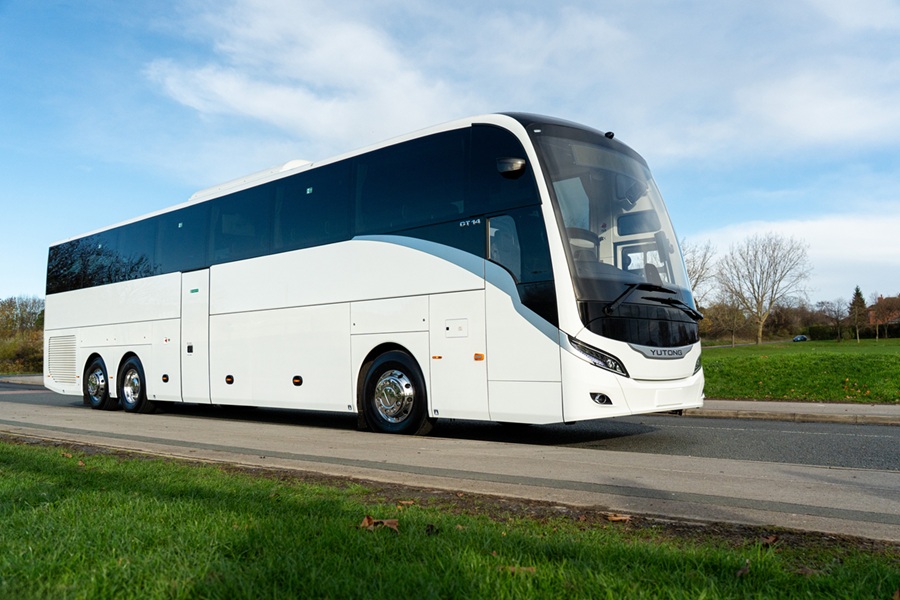
Yutong GT14 makes UK debut as operator interest in model builds
The first Yutong GT14 tri-axle diesel coaches have arrived at dealer Pelican Bus and Coach, with the supplier reporting strong interest in the type from customers as it further grows its product range.
In the full-size, high-floor field, the GT14 sits alongside the established two-axle GT12 diesel and the identically sized battery-electric GTe14 models from Yutong. It is powered by a DAF MX-13 engine developing 483bhp driving through a ZF EcoLife automatic gearbox, with the supplier noting how the newcomer is as much a furthering of the GT12 as the GTe14.
Of an initial 15-strong stock batch of GT14 coaches ordered by Pelican, 14 have arrived, with the first customer handovers to occur in week commencing 24 November. Ten more are due in Q1 2026 and a further batch of the same number in Q2.
Beyond that, one in compliance with the EU General Safety Regulation is on order as part of Pelican’s wider efforts to expand the Yutong coach range into Ireland next year. All the first 25 for the UK are sold, says UK Coach and Truck Sales Manager Simon Collins.
Bespoke 61- and 57-seat options on Yutong GT14
The GT14 comes in two configurations. Both are to the same 14m length, but the location of the offside continental door is adjusted to suit either a 61- or a 57-seat layout with a centre sunken toilet and ensure that legroom is optimised at each capacity, particularly behind the centre door. It will thus not be possible to reseat one version to the other.
Most stock coaches ordered by Pelican will have 61 seats, although a smaller number will come with 57. Pelican does not rule out further customisation of built-to-order examples, with Mr Collins noting how the GT14’s 3.92m overall height and 11 cubic metres of underfloor capacity gives good versatility in higher-end applications.
Seats are from Yutong in a moquette and synthetic leather trim. Each pair has a 240-volt power socket within the wall, with USB ports in seat backs. Among other seat amenities are lateral adjustment, a drop-down table, and footrests.
Saloon lighting arrangement part of 'business class' approach
One feature of the GT14 that Pelican is keen to promote is its internal lighting. Discreet down-facing illumination is below the windowsills, while the undersides of the luggage racks have full-length strips that can cycle through a variety of colours. That is set off by lighting within the ceiling.
When coupled to wood-effect flooring and a similar approach to side walls, albeit with a lighter tone, Mr Collins says that the desired effect is to represent elements of a full-service business class cabin in an aircraft.
While the GT14 shares much with the battery-electric GTe14 – including dimensions – other aspects are ported across from the successful GT12 two-axle diesel. The same seats are used, while the dash area is common. A large number of body parts are also shared across the three-strong GT range of vehicles.
Cab area echoes diesel GT12 rather than GTe14 electric sister
Production GTe14 coaches have a tablet-based driver interface, but the diesel tri-axle retains the more analogue approach of the GT12, albeit with a digital dash binnacle. That is deliberate, with Mr Collins noting a benefit in driver commonality between the two diesel coaches.
A camera monitoring system is standard on the GT14, and no conventional mirror option is offered. Also included is a 360-degree birds’ eye view via a dash monitor, while like other Yutong coaches, the newcomer arrives with the necessary pre-wiring for equipment to satisfy the PSV Accessible Information Regulations around next-stop announcements.
PSVAR compliance where specified is via a Hidral Gobel lift in a ski locker over the drive axle and Hanover silver LED destination displays. Those items of equipment will be added after arrival in the UK. Examination of one of the first coaches shows that the seating capacity of 61 falls to 55 when a wheelchair user is carried.
Conquest business prominent among early Yutong GT14 sales
Of GT14 coaches already sold, around 30% are to conquest buyers that have not yet taken Yutong products. Some sales are part of multi-unit deals. Retail customers and at least one large bus group are among initial recipients.
The GT14 "has opened up a completely new market for us,” says Mr Collins, who hints that the GT range could further expand beyond its current three members in the future.
Gross vehicle weight of the GT14 is 24,500kg, with a marked unladen weight of 15,600kg. Axles are from ZF all round, with Bosch steering at the rear. At 62mph, the engine is turning at around 1,250rpm in top gear; the offside radiator has 10 electrically controlled small fans to optimise cooling and minimise power draw.
Further details of the GT14 and other Yutong coach developments in the UK and Ireland will following in the December issue of routeone.

Alisons of Cambridge welcomes a distinctive Yutong GT12 arrival
Alisons of Cambridge has taken delivery of a new Yutong GT12, supplied by Pelican Bus and Coach.
It is finished in the operator’s metallic blue livery and has a grey-based interior scheme. Also part of the specification are the customary USB-A, USB-C and 240-volt power sockets, mood lighting, seats that include lateral adjustment, wi-fi, a fridge, and more.
Power comes from the DAF MX-11 engine developing 450bhp coupled to a ZF EcoLife automatic gearbox. Polished alloy wheels and a cherished registration mark complete the external appearance.
Says Pelican UK Coach and Truck Sales Manager Simon Collins: “We are very grateful for the support from Alisons of Cambridge. We look forward to seeing this coach up and down the UK, earning its keep.”
[adrotate banner="44"]
Higer V-Series debuts as Harris Bus and Coach builds plans for UK
Initial Higer V-Series coaches have been unveiled by dealership Harris Bus and Coach as it prepares to receive 37 vehicles from that range at three lengths as part of a 45-unit order from the Chinese marque for delivery to the UK in March 2026.
Alongside those coaches will be eight Azure battery-electric buses. The V-Series will be at nominal 10m, 12m and 14m lengths in diesel form as the V10, V12 and now the V14 as a tri-axle. The dealer says it is already committed to bringing the latter here in battery-electric form as the V14E under future range expansion.
Two V10s for the Irish market are currently in the UK for operator and dealer familiarisation. One of those is accessible; the passenger lift has been fitted in China, but UK coaches that comply with PSVAR will have such equipment from PLS or Dhollandia, with Hanover to fit destination displays.
On the bus side, a residual number of wheel-forward Steed battery-electric models are in Harris Bus and Coach stock. Once they are sold, needs in the mid-sized field will be covered by a shorter variant of the door-forward Azure to sit alongside the 12m type that is already established in Ireland.
For staffing, former MAN coach sales figure Chris Hunt has been named Head of Coach Sales by Harris in the UK. He parallels James Hooker as Head of Bus Sales and brings extensive experience in that field. The further developments follow previous news in August about the Higer brand's relaunch and early direction in the UK.

Higer V-Series will lead coach line for UK dealership
The V-Series coach platform is a development of previous models offered by Harris in the Super 9 midi and the 12m Pegasus. Cummins power is fitted across diesel examples, with the radical V-Series frontal styling already seen in left-hand drive format at Busworld Brussels.
Although the V10 is lower than its sisters, there remains significant commonality across the three coaches. As shown, the pair of Irish market V10s have Higer’s own seat finished in a synthetic black leather with diamond stitching and a range of comforts including drop-down tables, footrests, and lateral adjustment.
Harris Truck and Bus UK Managing Director Bill Laidlaw advises that stock coach builds will include a selection of trim configurations. Customer orders will also be taken with an estimated lead time of six months.
The pair of V10s already here display a tablet-based dash binnacle, with a separate tablet for other functions to the left. Cabin ambience is inviting, although Mr Laidlaw notes how UK coaches will have some relatively minor changes to those destined for Ireland, with work on final specifications to be confirmed shortly.

Stock models on order are 10 examples of the V10; 15 of the V12 to a mix of configurations; and 12 of the V14, with two of those to a more basic layout and 10 to suit touring work. A separate order for 25 vehicles for Ireland is also in hand.
Beyond diesel in coach, the V14E battery-electric is being worked up. Like buses from Higer, it will come with energy storage from CATL, with around 480kWh to be installed. Warranty coverage will be finalised shortly, but 15-year coverage is expected across electric products. Other V14E specification elements, including maximum charging power, are still to be agreed.
Around 30 UK coach operators will be shown the V10 pair during November. A roadshow will come later. Mr Laidlaw says that Harris Bus and Coach UK has been surprised by the level of interest already seen from potential buyers in both the coach and bus fields.
Azure battery-electric bus generating big group interest
Interest in the Azure bus is similarly building, with Mr Laidlaw noting how early discussions have been had with more than one of the large groups. Higer battery-electrics have already gained traction among private operators in Ireland, which is where the residual Steed models are expected to find homes.

As part of a five-year plan and in advancement of its position in August, Harris now expects to bring a diesel single-deck bus to the UK along with battery-electric and diesel double-decks. Such growth, and introduction of the V14E electric coach, is pencilled in to start in 2027.
Next year’s priority is to get dealers in place. Those will be drawn from the Maxus light commercial vehicle network, a marque that is also supplied by Harris Group, although Mr Laidlaw adds that some other parties have thrown their hats into the ring to support Higer vehicles.
Previously the Dublin-based business planned to have 10 Higer specialist outlets here, all offering aftersales support and eight of them also selling new vehicles. However, interest from such potential parties has been stronger than predicted and Mr Laidlaw expects those projected numbers to increase.
Complementing them will be a central Harris Bus and Coach base for the UK with showroom facilities, as premises already owned by Harris in Liverpool are expected to be outgrown. Cheshire is currently the favourite for that development. “It is all looking good for us in the coach and bus world,” Mr Laidlaw believes.
Further detail on the Harris Bus and Coach strategy for the UK and vehicle positioning will follow in the December issue of routeone.