
Eagles Coaches of King's Lynn among first to take Yutong GT14
Eagles Coaches of King’s Lynn is among the first operators to take delivery of a new Yutong GT14, supplied by Pelican Bus and Coach.
The opening examples of the 14m diesel tri-axle recently arrived in the UK and more will follow. That for Eagles Coaches is a 61-seat example with USB-A and USB-C charging points along with 240-volt sockets in the side panel. Each position has lateral adjustment to complement the many other comforts fitted to the GT14 as standard.
Power is from the DAF MX-13 engine developing 483bhp coupled to a ZF EcoLife automatic gearbox.
The rear axle comes with Bosch steering, while the driver gets a camera monitoring system in place of mirrors along with a 360-degree bird’s eye installation.
The coach is completed by a cherished 75-plate registration mark denoting the Eagles Coaches identity, and highly polished alloy wheels.
[adrotate banner="44"]

Yutong GT14 arrival sits alongside wider coach work for Pelican
Importer Pelican Bus and Coach has outlined its high hopes for the Yutong GT14 tri-axle diesel coach after the first of those arrived in the UK, with that work paralleling an overhaul of the TC9 midi and an entrance to the Irish market for the wider Yutong range.
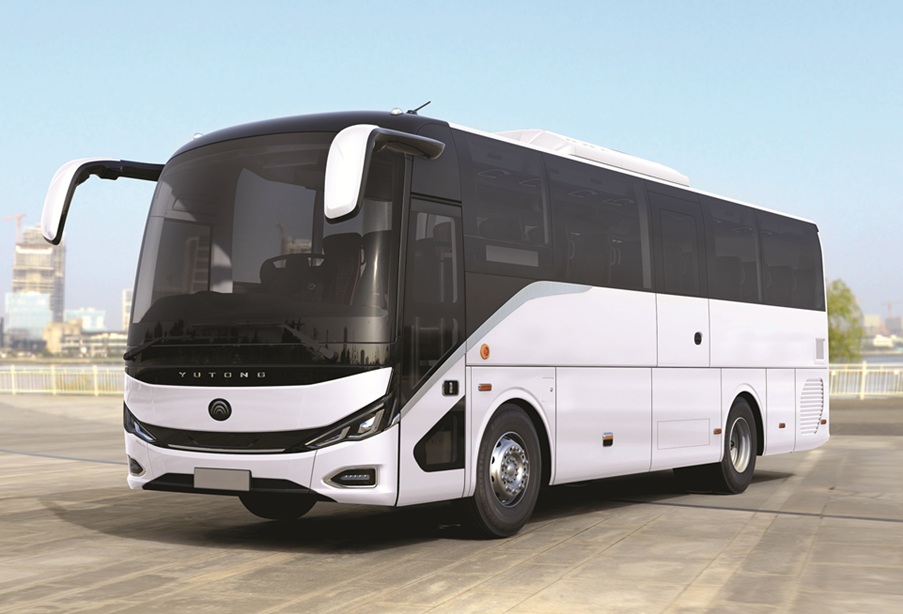
The 14-metre GT14 sits alongside the battery-electric GTe14, but it is described by the dealership as a model that builds on the established GT12 two-axle diesel coach. The driveline chosen illustrates that.
While the GT14 has the 12.9-litre DAF MX-13 engine rated at 483bhp compared to the smaller MX-11 at 450bhp in the GT12, ZF axles and the EcoLife gearbox are common. All three GT-series models share much from a body perspective including panels and other parts.
Two layouts for the GT14 are on offer. One is a 57-seat configuration that Pelican believes will appeal to the tour market; the other has 61 seats to suit private hire and scheduled service use.
Positioning of the continental door differs between the pair to optimise legroom, and so reseating of one to the other will not be possible. Pelican expects most bought to come with the higher capacity. Both layouts have a centre sunken toilet.
Of orders for the GT14 placed already, 14 of an initial batch of 15 are in the UK with several handed over to customers. A further 10 are due in Q1 2026 and then another batch of the same size in Q2. To tie with an entry into Ireland, a 36th example is also in hand; unlike the UK units, it will comply with the EU General Safety Regulation.
Yutong GT14 focused on multiple coach use cases
PSVAR compliance in the GT14 when specified comes via a lift mounted over the drive axle, with a large one-piece door there. As with other coaches in the Yutong range, destination displays and the lift are fitted after arrival in the UK, but all preparatory work is carried out at the factory.
Also added in China during production is pre-wiring for the necessary equipment to comply with PSV Accessible Information Regulations requirements for next-stop announcements.
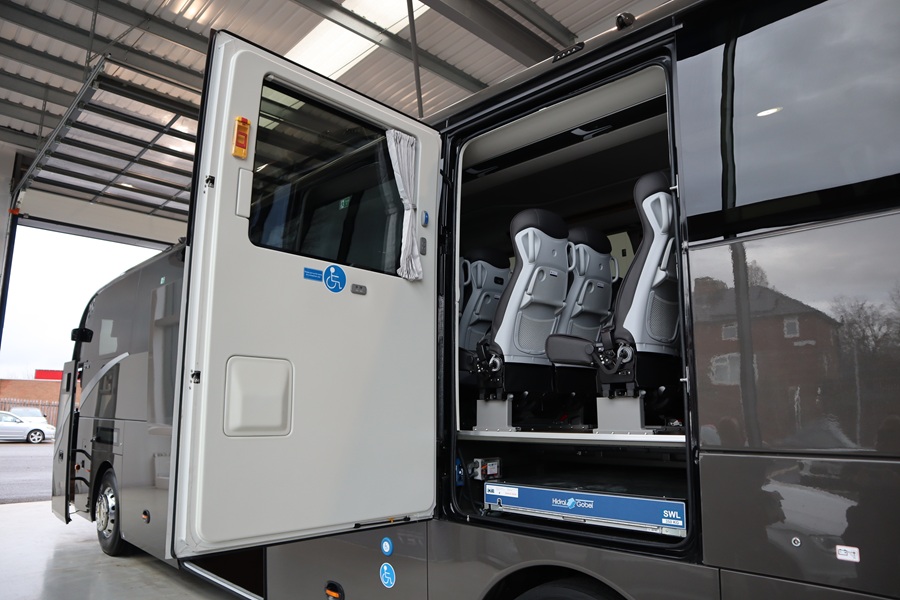
Pelican UK Coach and Truck Sales Manager Simon Collins notes how a single control unit governs the destination displays and next-stop information units, and that adding the wiring for the latter at build is much more cost-effective than retrofitting it later.
The GTe14 has a lift mounted at its large nearside centre door within the wheelbase and with internal steps, as befits a model first tilted at scheduled service work. Simon notes how at present there is no plan to offer that layout on the GT14, and vice-versa for the latter’s lift positioning to go into the GTe14.
The GT14 approach does not compromise underfloor luggage space, which stands at 11 cubic metres; that is viewed as important on a coach that is expected to appeal to tour work.
He adds that the GT14 also has potential for customisation to serve sports team applications, where maximising baggage capacity is also key. One of the first GT14s to arrive shows an unladen weight of 15,600kg, with GVW at 24,500kg.
‘Business class’ elements aspiration for cabin
In a further representation of development from the GT12, the newcomer has the same Yutong seat that goes into its two-axle sister, including identical trim combinations. That unit will also go into the next-generation TC9.
Interior lighting is cited by Pelican as a high spot of the GT14. It includes upwards facing perimeter illumination in the ceiling, similar along the length of both luggage racks, and downlighting within the windowsills.
That combines with wood-effect flooring and a similar, albeit lighter, approach within the panels beneath the windows to form what Simon says is an effort to replicate part of the full-service business class approach seen on premium airlines.
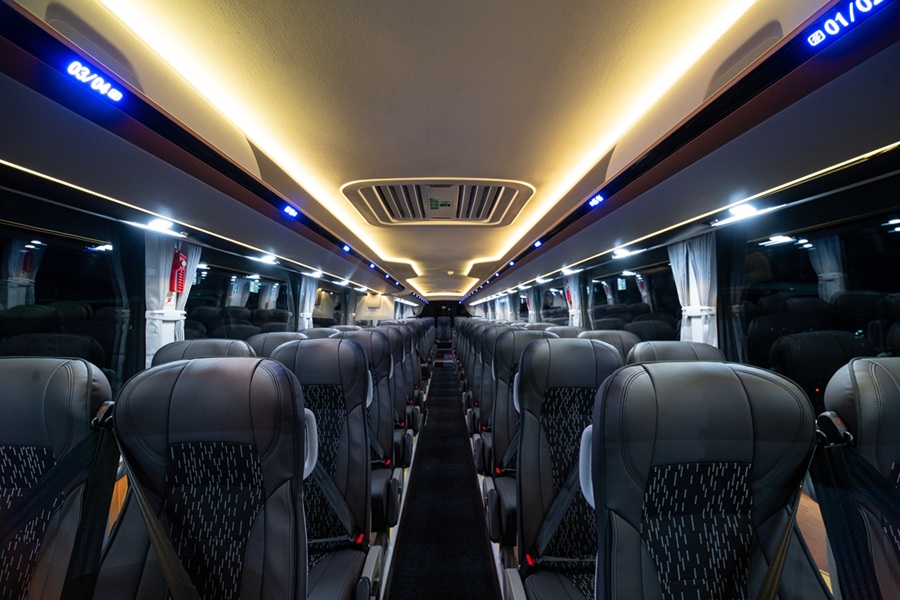
The lighting can display in various colours, and illuminated seat numbers within the luggage rack lips adds to the effect. Seats are to a high specification and have the full range of amenities including USB-A and USB-C charging points and lateral adjustment. 240-volt sockets are within the wall at each pair.
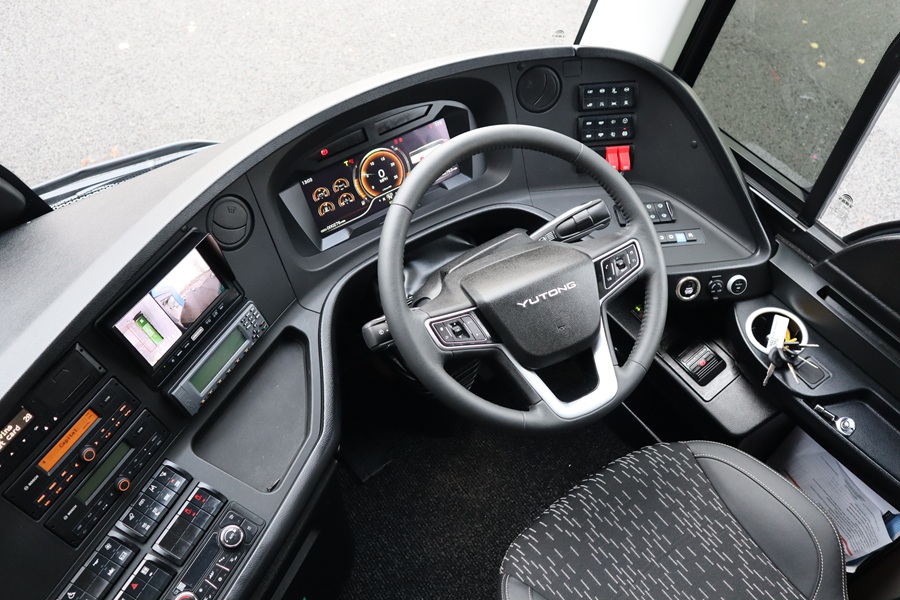
A cab layout like the GT12 is used, and not the GTe14. The latter majors on a tablet-based driver interface but the GT14 continues a more conventional approach. Simon notes how the diesel tri-axle is expected to appeal to existing GT12 customers, and thus driver familiarity is a consideration.
Standard on the newcomer is a camera monitoring system; conventional mirrors will not be offered. Beside the visibility and drag reduction benefits, maintenance costs are a factor. Pelican’s parts division supplies up to 10 mirror arms per month to replace those that have been damaged. The GT14 also comes with a 360-degree bird’s eye view via a dash screen.
Other elements of the new model include a high-specification Yutong driver’s seat, a Webasto coolant pre-heater, and a radiator arrangement with 10 small electrically powered fans. That allows airflow through the core and coolant temperature to be optimised while minimising power draw. Those fans will also come to the GT12.
Coach operator confidence coming quickly for GT14
While arrival of the GT14 further expands the Yutong coach offering in the UK, Pelican Managing Director Richard Crump hints that it may not be the last introduction to the range. He adds that the dealer saw rapid acceptance of the new model and that the first 25 have been sold ‘off plan’.
“Buyers are confident in the GT14, and they have found it instantly acceptable based on the success of the GT12,” Richard continues.
Simon adds that the mature position around the manufacturer’s products here and their high standard specification are further reasons for ongoing popularity. Although the market for 14m tri-axles is smaller than that for 12m two-axle coaches, it is expected that the GT14 will quickly cement itself.
Of those sold so far, most are to existing Yutong buyers, but Simon observes that around 30% have gone to conquest customers that have not run the marque until now. Multi-unit deals have also been done, and he notes that arrival of the diesel tri-axle has opened a new market in the UK to the brand.
Updated Yutong TC9 midi on the way soon
The GT14 is currently centre of attention for Yutong here, but other coach developments are in hand. Departure from China of the first of the next-generation TC9 midicoaches was imminent at the time of writing, with the final example of the existing variant having recently been delivered to Maynes Coaches.
Notably, the first batch of 50 new-shape TC9s are all sold and a further order of 15 has been placed by Pelican. A spike in TC9 deliveries is thus expected next year as the updated model comes online.
Simon observes how customer interest in the midi remains strong and that the revised variant offers multiple enhancements, including a slight length gain and an overhauled dash area.
A camera monitoring system for the TC9 is under development. Such a fitment is already optional on the GT12 and Simon believes that a position will be reached before too long where rear-view cameras are standard across the Yutong coach range here.
Ireland aims come into focus for Pelican
Sitting alongside work on products are plans for introduction of the Yutong coach range to Ireland. Pelican is working with dealer Central Bus and Coach in County Longford on that, but the Castleford business will also have its own dedicated salesperson in-country. Existing Area Sales Manager for Scotland Dale Ogg will add Northern Ireland to his territory.
The first coaches ordered specifically for Ireland with General Safety Regulation compliance included will arrive in Q1 2026. The GT12 and GT14 will come first, with the new TC9 to follow. In total, 24 are on order for Ireland and Simon anticipates up to 40 units per year as the likely fruits of that market.
On battery-electric coach, the low-height TCe12 and the large GTe14 continue to make headway. The latter has been a little slower to take root than Pelican had anticipated, but Simon says that the requirements for power in an operator’s depot is the restricting factor.
The GTe14’s minimum 563kWh of energy storage requires a strong connection, and some would-be purchasers have found that difficult to secure. Price of the electric tri-axle is not the constraining point, he believes.
Nevertheless, addition of its GT14 diesel counterpart means that the Yutong coach range in the UK has taken a further dimension. Whether its arrival represents a conclusion to the line-up’s expansion here remains to be seen, but the omens suggest not.
Harris Bus and Coach expands on plans for Higer marque in UK
Harris Bus and Coach has shared further details of its work to cement a presence for Higer vehicles in the UK market, with plans coming together ahead of the arrival of the first 45 such coaches and buses in March 2026 via the subsidiary of Dublin-based importer and supplier Harris Group.
Work on the Higer brand in the UK follows previous attempts to introduce its products here by Harris. They are already well established in Ireland. Of the new V-Series coaches, two have already touched British soil when the dealership brough a pair of V-10s (one pictured, above) ultimately destined for Irish customers to Donington Park in November for introduction to potential buyers and parties that will form part of its dealership network here.
Cummins power is used across the board in those, with the V-10, V-12 and V-14 names based on the coaches’ nominal lengths in metres. The longest is now the V-14, a tri-axle product at 14m; the 10m V-10 and the 12m V-12 are both on two axles. Each of those products forms part of the stock order for the UK already placed.
Complementing them is the Azure battery-electric single-deck bus. It has already been sold in 12m format and a 9m example will follow. The latter is to door-forward layout and will succeed the wheel-forward Steed that has sold in modest numbers in both the UK and Ireland.
Harris Truck and Bus UK Managing Director Bill Laidlaw oversees operations here. Those are currently headquartered in Liverpool, but a coach and bus centre including a showroom is being worked on. Cheshire is suggested as a location for that, with a hope that Harris Bus and Coach affairs in the UK will be self-sufficient by 2027.
Harris Bus and Coach team boasts UK market experience
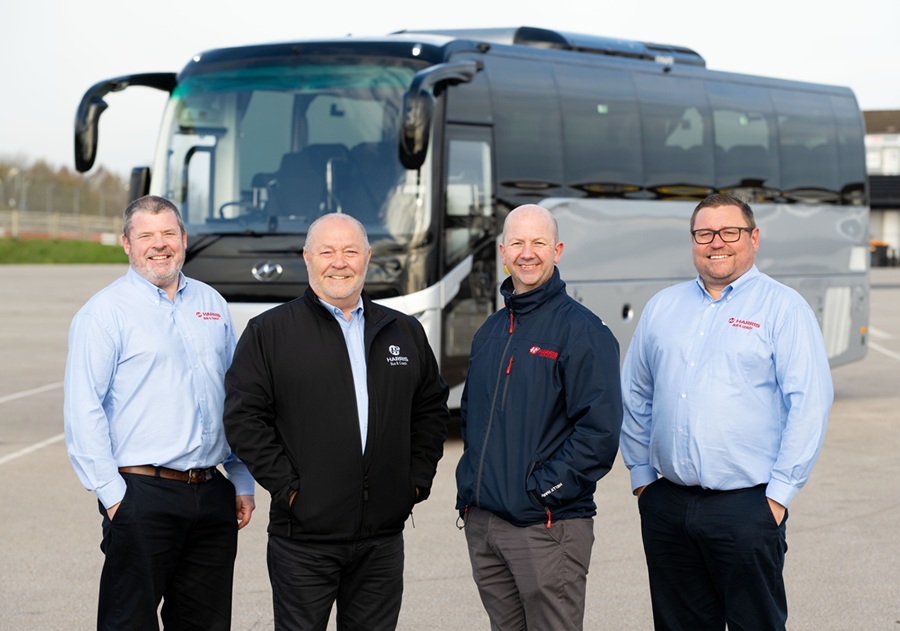
A more recent addition to the Harris Bus and Coach sales team here is Chris Hunt, who counts MAN and Optare as former employers. He is Head of Coach Sales and sits alongside James Hooker as Head of Bus Sales. Head of Aftersales Bus and Coach Wayne Ulph adds further passenger sector knowledge to the Harris team.
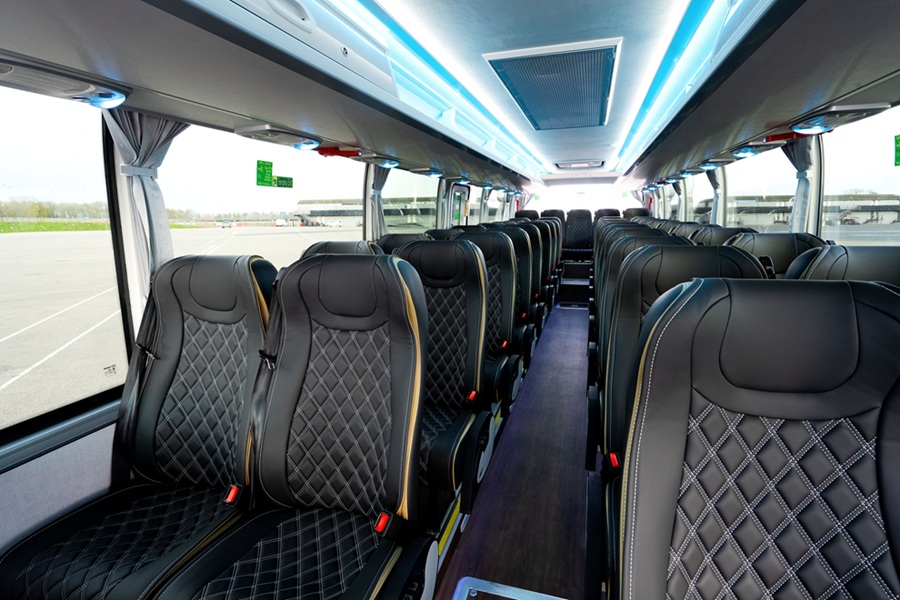
Of products, the V-10 coach promises a maximum of 43 seats and the V-12 will go to 55. The V-14 will reach 61. Power in the smallest vehicle is from the Cummins B6.7 engine developing 320bhp, while in the V-12 it comes from the X11 at 400bhp. In the V-14 will be the X12 developing 490bhp. All will drive through the ZF EcoLife automatic gearbox.
The V-Series is broadly based on existing Higer coach products, but they have received major upgrades including new body shells and styling, new electrics, upgraded braking systems, and much else. Perhaps most noticeable to passengers will be the headlight and daytime running lamp arrangement; it forms part of what Higer describes as a butterfly wing panel.
Coach and bus both within first Higer stock order
For bus, the Azure 9m will seat 28 passengers with a maximum capacity of 62. It will have 263kWh of batteries. The Azure 12m, as already sold, gives 42 seats and energy storage of 363kWh. Bill observes how 481kWh can be fitted, but the drive axle weight limit prevents that for the UK. He is hopeful of upward movement in the future. CATL supplies the batteries and Bill is targeting a 15-year warranty on those.
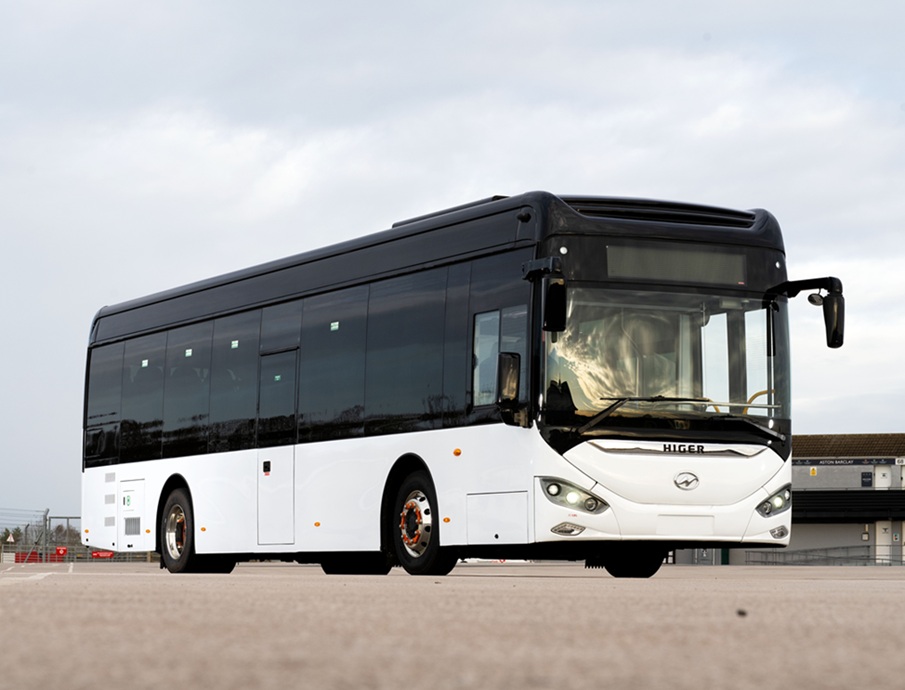
The 45-unit stock order is broken down into eight Azure buses and 37 coaches. Of the latter, 10 will be the V-10, 15 will be the V-12, and 12 the V-14. Different specification levels are in hand for the two larger coaches, spread across a standard approach and one to suit touring applications. Internal colour schemes are also varied.
PSVAR compliance will be available across the coach line-up. On the V-10, lift location is within the wheelbase, while for the V-12 it will be above the front axle. The V-14 will see that equipment mounted over the rear bogie. Dhollandia and PLS will supply lifts and Hanover the destination displays. All such units will be fitted after arrival from China.
Bill notes that further coach and bus stock orders will be laid with Higer and that Harris has committed to 150 units across the UK and Ireland in 2026.
Dealership approach is key to customer offer from Harris
While Harris Bus and Coach will have its own central facilities and staff in the UK, regional dealers will play a part in the sale and support process. Some will be drawn from those already working with Harris Group on Maxus light commercial vehicles, but Bill says that other parties have also shown interest.
“Harris has 90 Maxus dealers in the UK. We wanted some of those to come aboard as coach and bus partners but the interest received has surprised us,” he adds. A number of coach operators have also enquired about working with Harris on product support. Around 30 coach companies were represented at the Donington Park event.
At the time of writing, 17 dealers were confirmed as aftersales points and discussions were underway with more. Specialist electricians will also be engaged to underpin products.
Bill notes how since news of Higer’s further targeting of the UK broke in August, momentum has built quickly. In addition to the Donington event, representatives have been in the market engaging with potential buyers. Where a stock vehicle is not right for the customer, lead time on built to order examples is quoted as around six months.
Larger range of vehicles promised for the future
Thoughts have already turned to the longer-term future of Harris and Higer in the UK. Work in 2026 centres on getting vehicles into the market and building the support network, but from 2027 onward, the mutual five-year plan captures range expansion. Beyond that to 2030, autonomous vehicles, environmental, social and governance partnerships, and market consolidation are on the agenda.
On future vehicles, Bill advises that a diesel single-deck bus is planned alongside double-deck products in diesel and battery-electric format. Also on the cards is a 14m V-14E battery-electric coach; he describes that as “a commitment” and notes that 481kWh of energy storage is planned for the model.
Full details of that coach are still to be defined. It is likely to accept a high power when charging, but Bill is a further manufacturer representative to point to infrastructure as being one of the primary blockers to uptake of battery-electric coaches. At present, he notes, scope to charge them is limited – and that constrains sales.
Nevertheless, Higer has already built battery-electric coaches on two axles for other European markets. One of those – a V-12E bound for Iceland – was exhibited at Busworld Brussels in October.
Coach line-up shows promise already
Of the V-10 pair brought to the UK in November, both suit Irish requirements and there will be some minor differences on those that are built for here. Otherwise, they give a good idea of what to expect, and routeone was able to drive one around a brief circuit.
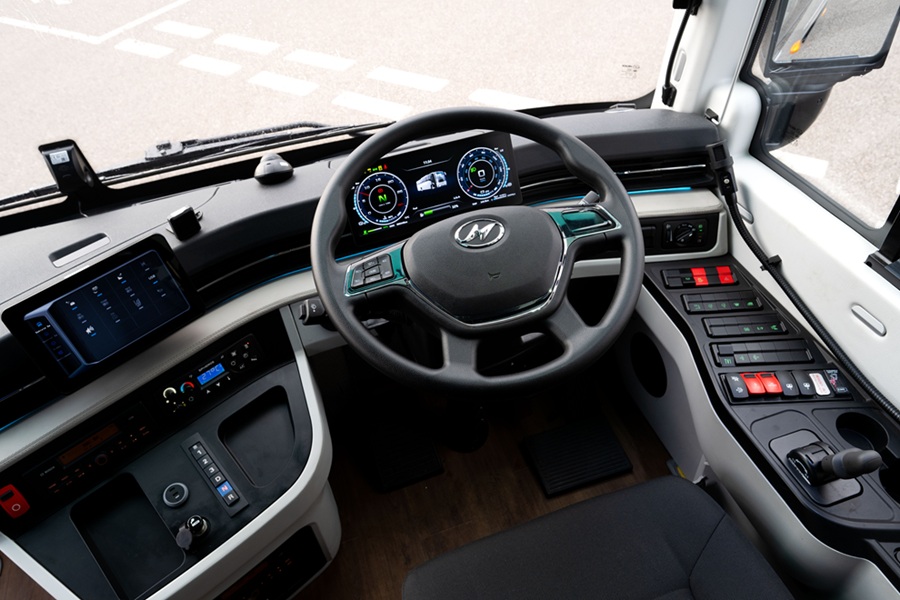
The cab area is modern and the binnacle is tablet based. Switches, the handbrake, other controls and the tachograph unit are broadly well placed, although the steering wheel and column would benefit from greater adjustment for larger drivers.
The 320bhp Cummins engine does well and ride quality is good. Anecdotal feedback from coach operators present at the Donington event also signalled rapid acceptance of the V -Series into the UK if the V-10 is a guide to what to anticipate of pending coach models.
The 12m Azure was also available to drive. It is a standard battery-electric bus; smooth and silent, with immediate pick-up. Unusually, it has a ‘power’ mode that can be selected by the driver. When utilised, there is a noticeable change to performance, but some buyers may seek to have it deactivated.
Positivity around the Harris Bus and Coach work with Higer has spread around the supplier’s staff, who combine longstanding sector experience with wider commercial vehicle knowledge. “Things are looking good, and the team is greatly anticipating the arrival of vehicles and getting them into the market,” says Bill. “There are still some tweaks, but I am confident that we will get to where we need to be.”