
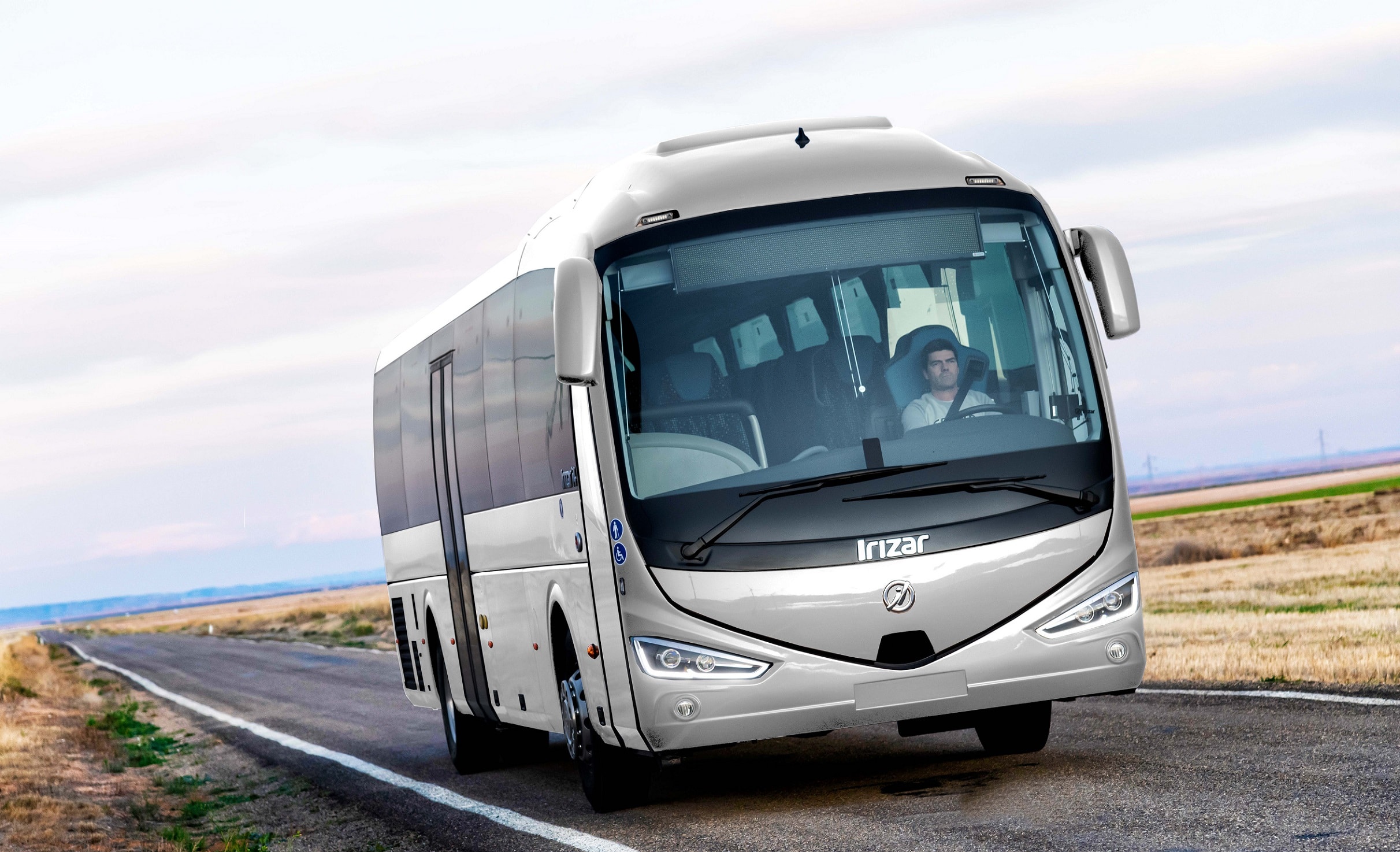
Irizar adds PSVAR compliance to 70-seat, two-axle i4 integral
Irizar UK can now offer ex-factory PSVAR compliance on new two-axle, 70-seat variants of the i4 integral coach. The development has come after the Spanish manufacturer undertook further work to remove weight from the low-height model.
In such a configuration, a Masats wheelchair user lift is mounted within the steps of a 1,100mm-wide centre door. Seats are in 3+2 layout. The 70-seat, PSVAR compliant i4 integral remains powered by the 10.8-litre DAF MX-11 engine and the ZF EcoLife automatic gearbox is available as part of its specification.
Irizar says it has taken up to 955kg out of the i4 when compared to its previous iteration, depending on specification, and optimised axle weights. That and other “innovative technology solutions” mean that fuel economy for the model is also improved by up to 5%, the OEM adds.
Irizar first introduced an overhauled i4 product at Busworld Brussels in 2019. At that point it had received a redesign, which includes the utilisation of high-strength steel to replace what the manufacturer calls “traditional structural methods.”
Further work to reduce weight has been carried out since then, which has permitted Irizar UK to introduce the new variant. The same efforts also enable Irizar to now build the i4 in integral form on two axles at 13.2m and with up to 63 seats in 2+2 layout.
That configuration is targeted largely at scheduled work and thus it will not proactively be offered by Irizar UK. However, Sales Director Julie Hartley adds that if interest is present among UK operators, the dealership will work to introduce the 13.2m two-axle product here.

Bus Open Data Service: Rise Digital Media and vehicle location
There is a pressing need for operators of services in England outside London that are within scope of the Bus Open Data Service (BODS) to comply with its requirements for fares, timetables and vehicle location. The Department for Transport (DfT) through its data analytics partner has made clear that there is now an expectation for them to engage fully with the Service.
Vehicle location data is easily provided where latest generation ticket machines are used. Where they are not – as would typically be the case on home-to-school services that are in scope – things are more difficult. Such information must be provided. DfT’s grace period for BODS compliance expired in January, and operators that do not take heed will find that the matter is escalated, a representative of the data analytics partner said during that month.
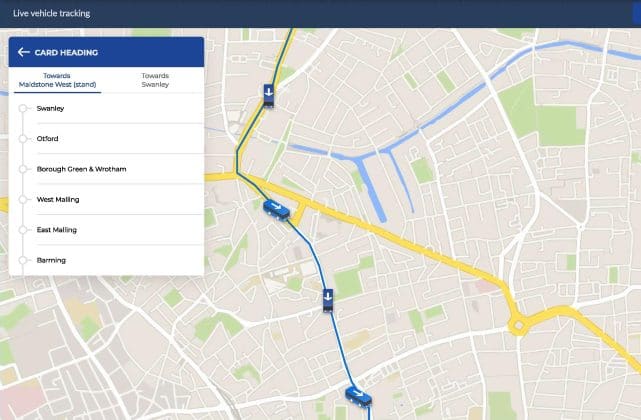
Rise Digital Media says it has a simple and cost-effective product to report vehicle location data to BODS. It is delivered through the supplier’s NextStop mobility platform. NextStop is a comprehensive dashboard-based data product that provides various services. Users extend from SMEs to large bus groups. When utilised for vehicle location, it publishes the required Service Interface for Realtime Information for Vehicle Movements (SIRI VM) feed direct to BODS.
“BODS compliance is one aspect of the NextStop platform, to which we can easily add others,” says Rise Digital Media Operations Director Chris Nice. “But all users, regardless of the functionality that they purchase, receive access to the dashboard.”
That interface can deliver live service and vehicle movement information, punctuality reports, individual stop data and much else. All can be filtered and downloaded for offline storage. As an example of NextStop’s further functionality, Rise is currently using it to work with two large household retailers on the provision of staff transport services.
Simple approach to Bus Open Data Service vehicle location
When employed for SIRI VM purposes, Rise’s interface on the vehicle is delivered via an app built for Android. Effectively, the device used acts as a live tracking unit. NextStop uses the information created to generate a SIRI VM feed that it publishes direct to BODS, where it sits alongside other data required for compliance.

Rise can lease stock devices to customers, or the operator can use their own.
They may be fixed within the vehicle or portable. Each driver has their own log-in details, to which they must add some further information when using NextStop so that it knows what route and journey is about to be undertaken.
Ensuring that drivers select the correct options there is important, Chris adds. The app is then connected to BODS.
A consideration with vehicle-mounted tracking devices is cellular network coverage. “If an operator is in an area that has poor or intermittent mobile internet connectivity then the NextStop driver app will continue to attempt to connect to the internet until it is successful,” he continues. “The app does not require a manual refresh or a push for reconnection.”
Bolt-on based package from Rise Digital Media for extras
Rise levies an initial setup charge for NextStop. When utilised for BODS vehicle location compliance, the separate usage fee is based on the number of devices on a per unit, per day basis. That brings with it access to the dashboard and the reporting that can be obtained from it.
Additional bolt-ons can be purchased. One that is relevant to home-to-school services is the ability to send push notifications, which in some cases is tied with NextStop’s mobile ticketing capability. Those could go to parents informing them that their children have boarded, or to the operator’s control room informing it of late running or congestion.

“A number of our clients already use this functionality, which also allows schools to be notified if the vehicle is delayed,” says Chris.
“Another capability that can be enabled is to permit messages to be sent to the driver, for example if they need to change the route.”
Among operators that use NextStop is Lynx of Kings Lynn, which has been working with Rise for over two years. Commercial Manager Graham Smith describes Rise’s products as “invaluable to our customers,” adding that the vehicle tracking through the web platform and app is reassuring that while a bus may be delayed, it is still on its way.
DfT approach to Bus Open Data Service compliance changing
While complying with BODS is seen by some as a further burden upon an already challenged industry, DfT has made clear that it is not optional when services are within scope. Chris acknowledges the cost and time implications that come with complying, but he notes that in a world where technology is omnipresent, in its wider format BODS has the potential to attract passengers.
“DfT has altered its tone on BODS a little in recent weeks. It will not now tolerate excuses; instead, it expects operators to be ready to comply, and not just in the process of preparing themselves to. DfT is reaching a position where it will start looking closely at those that are non-compliant.”
Rise advises that operators which are still struggling with BODS should join one of the webinars hosted by DfT’s data analytics partner. Details of them are communicated regularly. Financial support towards achieving compliance may be available; while it is not guaranteed, DfT “wants people onboard rather than to catch them out,” Chris concludes.
Contact Chris Nice on 0203 422 9115 or via email: [email protected]
New Routemaster battery-electric repower makes debut
Equipmake has repowered a Wrightbus New Routemaster with a battery-electric driveline, with the vehicle making its debut at Euro Bus Expo.Â
The zero-emission package, which includes 400kW/h of battery storage and the supplier’s HTM 3500 400kW electric motor, is expected to deliver a range of 150 miles. It is fitted to a New Routemaster that is part of the Metroline fleet.Â
The bus will now act as a evaluation vehicle. Equipmake is also showing at Euro Bus Expo an Optare Versa EV in the First York fleet that has been repowered with the Snetterton company’s battery-electric package in place of the OEM zero-emission driveline.Â
Over the coming six months, Transport for London will obtain data from the repowered New Routemaster as part of its evaluation of a range of technologies. Charging infrastructure for the vehicle has been installed at Metroline’s Holloway depot by Zenobe, which is also providing battery data analytics.Â
Part funding for the New Routemaster retrofit by Equipmake has come from the Advanced Propulsion Centre. The supplier says that it “will be trialling additional repowered buses with other operators across the UK†over coming months.Â
With the battery-electric New Routemaster’s debut, Equipmake CEO Ian Foley has underlined his belief that repowering is a “vital†transitionary technology.Â
Adds Mr Foley: “We are delighted to showcase our latest repower system in the shape of a zero-emission version of the iconic New Routemaster double-decker. London is leading the way in the adoption of green technologies for large commercial vehicles, and as TfL continues to evaluate a range of clean technologies, we are confident that our repower systems can play a rapid role in accelerating any zero-emission vehicle strategy.â€Â
Comments Metroline Engineering Director Adrian Jones: “Metroline is delighted to trial this innovative fully electric New Routemaster bus in London. Repowering technology has huge potential in enabling operators to accelerate the transition of fleets to zero emissions and we look forward to further evaluating this test vehicle over the coming six months.â€Â
Equipmake says that its repower driveline can be installed to any existing diesel or diesel-electric hybrid bus.
Euro Bus Expo is being held between 1-3 November at the NEC Birmingham. Register for free tickets here. Equipmake will be on stand A30.