
Irizar i3 Normal Floor electric low-height coach expected for UK
Irizar has launched an i3 Normal Floor battery-electric low-height coach that the builder expects to come to the UK in due course.
The product debuts at Busworld in 12.2m, two-axle form, although Irizar says other lengths will follow. As shown, it has 528kWh of battery capacity using lithium iron phosphate chemistry, although other battery choices will come as the breadth of the model expands.
Up to 53 passengers can be carried. The show example has a Masats passenger lift at its broad centre nearside door, with room for a wheelchair user directly opposite.
A range of up to 450km is claimed by Irizar. Six battery packs are fitted: two at the rear, and four on the roof. Charging is via CCS2 at up to 150kW, with front or rear connection options. The model is also compatible with pantograph-based opportunity replenishment at 300kW.
Irizar Group CEO Imanol Rego says arrival of the i3 Normal Floor “completes the offer of the i3 [range]," which thus far has been deployed in low-entry bus applications. He adds that growth of the Spanish OEM's zero-emission range continues a path of decarbonisation “with a technological neutrality.”
Over seven cubic metres of underfloor luggage space is included, with options of manual or powered bay doors. That is part of what Irizar says is “a completely vanguard design” to maximise passenger and baggage space.
Drive is taken via a 260kW motor coupled to a three-speed gearbox. The manufacturer adds that it has worked hard on the vehicle to leverage serviceability. All electronics are within the interior and not outside the cabin.
Some components in the i3 Normal Floor are shared with other Irizar products. The new model will be available only with a camera monitoring system; no rear-view mirror fitment is expected. It also complies with EU R29 regulations on driver and passenger protection in a head-on collision.
On right-hand drive plans, Irizar Export Sales Director Javier Goikoetxea notes that “there is a demand” in the UK for such a coach, although he cautions that coming of a right-hand drive variant will follow work in left-hand drive.
Mr Goikoetxea adds that development of the Irizar i6S Efficient Hydrogen fuel cell-electric high-floor coach continues. A prototype of that vehicle was shown at Busworld in 2023. The first example of a second-generation of the i6S Efficient Hydrogen is in build.

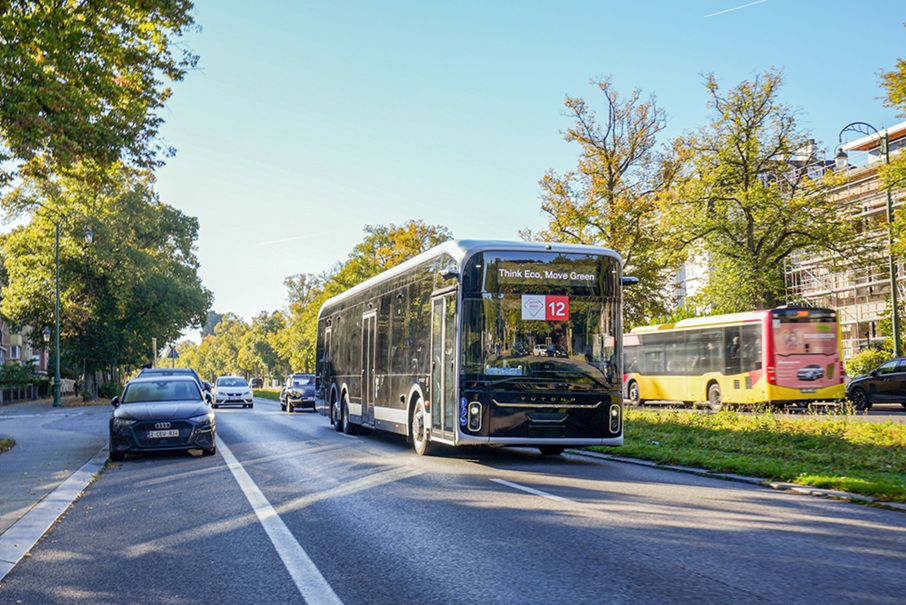
Overhauled Yutong U11DD gives model access to London market
Yutong has shown a second-generation U11DD battery-electric double-deck bus that meets Transport for London requirements and will allow it to enter that market via compliance with the contracting body's Bus Safety Standard.
The vehicle is a development of the existing U11DD. It includes a flat floor in each saloon with improvements to the layout at the rear of both via a repackaging exercise.
Dealership Pelican Bus and Coach advises that the new version will be sold to all customers, not just Transport for London contractors. The example shown at Busworld is a seed single-door example. Revised design aspects having been led by feedback from the UK. Buses will continue to be completed by Pelican after arrival here.
Energy storage of 417kWh will be fitted, Head of Yutong UK Ian Downie has clarified. Some of that is now mounted around the chassis thanks to use of thinner packs. He adds that a single-motor arrangement will continue to be used in production buses.
Development of a next generation of the Yutong U11DD that suits London follows success for Pelican with the initial variant, which was first seen in 2023. Around a year later, First Bus ordered 127 of the type as part of a larger deal for Yutong electric products. Several other buyers have also taken the U11DD.
Battery-electric products in left-hand drive sitting alongside the latest U11DD at Busworld are the T14E battery-electric coach, which is the equivalent to the UK’s GTe14; and the U12 and U15 buses. The latter is a 15m, tri-axle model has 663kWh of energy storage and deliver a claimed range of 850km under SORT2 conditions, Yutong says.
Completing the show line-up is the IC12E, a 12.7m interurban low-height battery-electric coach. It debuted earlier in 2025 and is built in left-hand drive form; 465kWh of battery capacity gives a claimed 675km range when tested under SORT2.
The manufacturer’s latest generation of battery technology has also been highlighted. Yutong Europe CEO Jack Li used Busworld to explain how it forms part of the wider Yutong EV Long-life Tech approach being rolled out. He says that the new battery is designed for a 15-year/1.5 million km life while not falling below 70% state of health.
The Yutong Europe chief adds how the Long-life Technology platform uses a flat-wire motor with a 20-year/two-million km design life. The manufacturer notes how low resistance and hairpin winding technology “greatly improve motor efficiency and reliability.” A seven-in-one controller is also incorporated.
VDL Futura 3 makes debut as builder's new flagship coach
VDL has unveiled its keenly awaited Futura 3 coach, which the Dutch builder has already said is due to debut in right-hand drive form during 2027.
The new model made a first showing ahead of Busworld Brussels and maintains the outgoing Futura FHD2’s position in the premium field. VDL says it will deliver an up to 15% like-for-like fuel consumption reduction compared to the existing vehicle. Factors heavily influencing that are improved aerodynamics and reduced weight, the builder adds.
As a result, VDL Bus Group Managing Director Marc van Doorn notes that the Futura 3 will give “significantly reduced” total cost of ownership. Describing it as “an outstanding new coach,” he adds that the Futura 3 is the fruit of years of continual development.
On right-hand drive plans for the Futura 3, VDL says that besides the debut 12.9m FHD3-129, later additions to the portfolio will include the 12.2m FHD3-122 and the 13.9m FHD3-139. All will be available with wheelchair user access via a lift. A maximum of 59 seats is possible in the 12.9m variant.

For the FHD3-129, the manufacturer says unladen weight starts from 12,800kg. Lightweight materials and seats and optimised construction techniques contribute to that.
Observing how almost 5,000 Futura FHD2 coaches have been built in the 15 years since the type's launch, Mr van Doorn outlines how the new model brings forward VDL’s vision for long distance travel.
“It meets the demands of tomorrow while staying true to the trusted DNA of the Futura range,” he continues, noting how the Futura name traces its origin as far back as 1982 with the original Bova coach.
Feedback from operators, passengers, drivers and the aftersales network has been built into the Futura 3. VDL adds that the new model is prepared for later updates “including future alternative powertrains.”

Although lineage from the Futura FHD2 is clear in the Futura 3, the newcomer has a rounded front profile, an optimised roof structure and even what VDL calls “intelligent wheel finishing” to benefit airflow.
Power continues to come from DAF. The two coaches at Busworld have the MX-11 generation 3 engine that develops 450bhp driving through the ZF Traxon 12-speed automated manual gearbox. Careful selection of axle ratios means that the MX-11 operates in its most efficient range at a road speed of 62mph.
Despite that debut powertrain configuration, VDL has reiterated that the Futura 3 offers flexibility in driveline solutions to enable buyers to tailor the coach “to different applications and driving conditions.”
Within the saloon, the climate control system has been “completely redesigned.” At its heart is a high-performance air-conditioning unit in two configurations: one for milder climates in western Europe, and the other to suit the south of the continent. Both are calibrated for maximum efficiency, VDL says. Convector heaters are now used.
Stairs at both doors have been worked over to improve saloon access, with those efforts at the front maximising platform space. Toilet access is similarly improved, and the cubicle is all-new; that has come from specialist Shades Technics and is described by that supplier as a complex product that is assembled – including the steps – in the UK before shipping to VDL in the Netherlands.
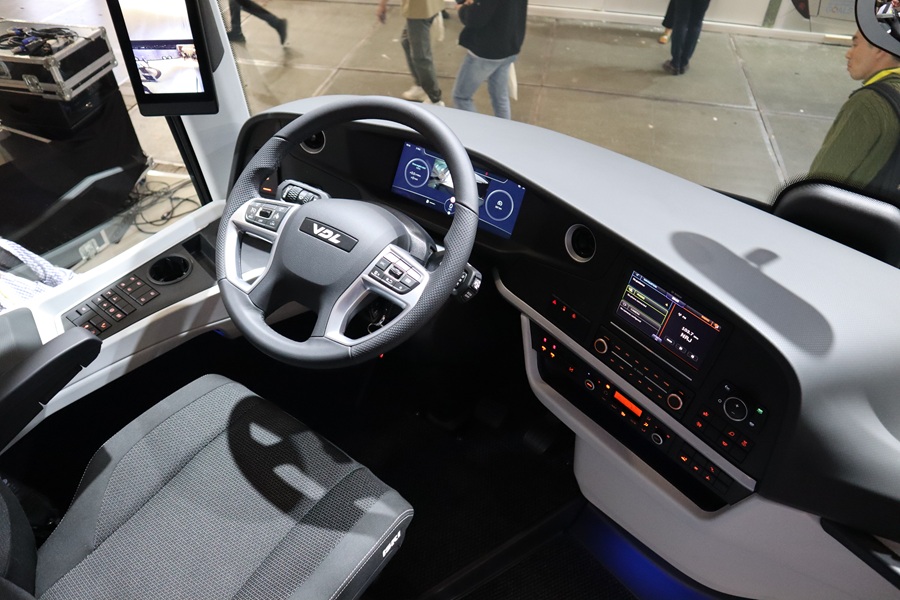
For the driver, a camera monitoring system in lieu of conventional mirrors is optional, while full-LED headlights improve performance and reduce fatigue. Visibility from the cab is improved, but at its centrepiece is a cockpit that VDL says “feels intuitive, ergonomically refined, and instantly familiar to any driver.”
Consideration in that field by the builder captures items such as storage space, tachograph unit location, switch configuration, and steering position. The latter has been overhauled to improve adjustment scope. The Futura 3 also comes with a digital dash binnacle and an electronic parking brake.

From a maintenance perspective, VDL says that design of the Futura 3 coach saw great attention paid to making that process simpler, faster and more cost-effective.
To that end, it has changed the windscreen wiper mechanism, amended the front and rear bumper designs to three-piece arrangements, and optimised access to the air-conditioning system and other items. A less curved windscreen reduces internal stress within the glass, lowering the risk of damage and simplifying replacement.
Other elements of the 12.9m, left-hand drive debut coaches are 900-litre twin fuel tanks with 45-litre Ad-Blue capacity; a 3kW inverter; 11.50 cubic metres of underfloor luggage capacity; and a host of safety systems.