
Coach products are a growing focus area for a busy Wrightbus
Entry to the coach segment by Wrightbus is positioned as a natural extension of its bus building activity, and for now the thinking around products captures two lines: the diesel-fuelled Contour, built by King Long in China, and a platform that will be designed and manufactured in-house and which will debut as a maximum-dimensions double-deck using hydrogen fuel cell-electric propulsion.
Much about the Contour is already known, with that Cummins-powered vehicle having broken cover earlier in 2025. From there things moved quickly, and development of the Contour’s specification is shown in a second demonstrator.
That coach is left-hand drive and bound for Germany, where Wrightbus is making strong headway with the supply of hydrogen buses. Moreover, 39 Contours have been sold to Bus Éireann for use as school coaches in Ireland.
Head of Coach Sales Dave Porter advises how the hydrogen coach project has accelerated recently. The first vehicle is expected to be completed within the coming 18 months, and early consultation of potential buyers has generated a positive response.
In that opening form, the 15m long, 4.2m high double-deck is aimed squarely at scheduled service operation to start with, but there is scope to build below those parameters later on the modular platform.
Wrightbus CEO Jean-Marc Gales adds that a diesel variant is likely to follow in 2027. Renderings of the initial double-deck concept show that Wrightbus is looking to a striking visual appearance for its newcomer.
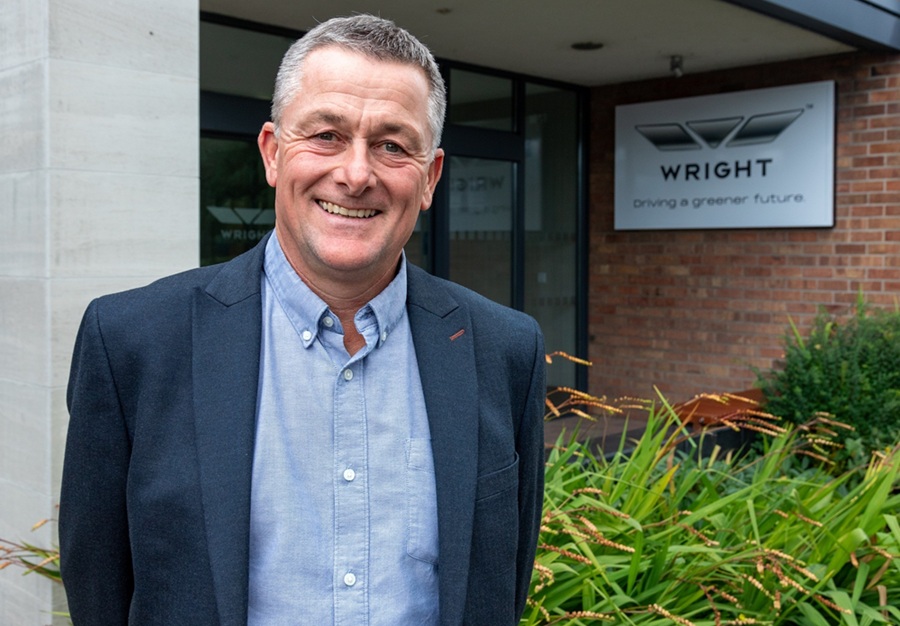
Contour gives Wrightbus good coach starting point
The Contour is built at 12.2m on two axles. Lead time from order to delivery is between six and eight months, although Wrightbus does not intend to hold the product in stock; all will be built by King Long to customer order. Sister business AllServiceOne will support Wrightbus coach products. That involves parts supply and delivery of training as an extension of its work with bus operators.
Exact pricing of the Contour is not disclosed, but Dave says it will be competitive. The left-hand drive demonstrator gives an excellent idea of what customers in the UK and Ireland can expect, with the Cummins X11 engine rated at 400bhp driving through a ZF EcoLife automatic gearbox and turning at 1,250rpm at 62mph.
As shown, it has 51 Fainsa Gala seats in a cream and blue configuration and a centre sunken toilet, although if that is deleted, capacity increases to 55. Compliance with the PSV Accessible Information Regulations can be specified, while for PSVAR the model comes in fully compliant format or ready for later conversion alongside a variant without accessibility equipment.
Specification elements typical of a coach in its class are fitted, including USB charging points, wood-effect flooring, twin monitors and convector heaters. Legroom is variable, particularly on the continental nearside behind the toilet. Rear-view mirrors are installed on the demonstrator, but a camera monitoring system is available and will be used on the Bus Éireann vehicles.
The cab has a digital dash binnacle, and the Contour fully complies with the General Safety Regulation to suit plans to sell it in the EU. Dave notes how care has gone into the underfloor luggage area, which is also treated with wood-effect flooring. Powered bay doors are fitted along with a coolant pre-heater. There is good space around the engine, while the radiator has seven small electrically powered fans.

Contour demonstrations with operators to start in 2026
“Wrightbus has taken this product off the King Long shelf and then worked closely with the builder to improve it,” Dave explains. Wrightbus staff are present in the Xiamen factory for quality control purposes, and a thorough pre-delivery inspection will be carried out after shipping to the UK and before dispatch to the customer.
Bus Éireann representatives have visited China to carry out an in-depth acceptance process for its batch. The first vehicle passed with minimal attention required.
Already Dave has made two trips to Xiamen. His many years of coach knowledge – which began in the workshop before moving to sales roles – are coming to fruition in the Contour through guidance to the builder around specification and configuration, and early engagement with potential buyers.
The latter work will accelerate with right-hand drive demonstrators due to be ordered soon, and a programme of in-service evaluation will start in 2026. Dave advises that work to deliver further Contour developments with additional capacity is progressing positively. More minor incremental advances are also expected as part of a programme that he says will reestablish Wrightbus as a player in the coach field.
Hydrogen leads Wrightbus in-house coach platform
While the Contour utilises an existing vehicle as a base and develops it with knowledge of European operator requirements, the hydrogen coach product is a different animal and is being created using a clean-sheet approach.
All design work is being undertaken in Northern Ireland, and chassis construction and framing is also to be done there. In debut double-deck, hydrogen-powered form, the vehicle will have 69 seats on the upper level and 15 downstairs. Two wheelchair user spaces will also be present, and those passengers will board at the front door and travel in dedicated areas behind the steer axle.
A bulkhead within the wheelbase will divide the lower area into seating and luggage space. As designed, that will deliver 10 cubic metres of baggage capacity, but Dave notes how there will be scope to adjust the split should buyers wish.
Significant work has already been done on the cab area and ensuring that the staircase behind it is as space efficient as possible to leverage the upper deck layout.
Over the rear bogie and behind it will sit the fuel cell and its accompanying CATL batteries. Hydrogen storage will be in this area. Wrightbus evaluated whether use of liquid hydrogen would be feasible, but supply realities mean that gaseous form has been adopted. A decision on whether it will be stored onboard at 350 or 700bar is awaited.
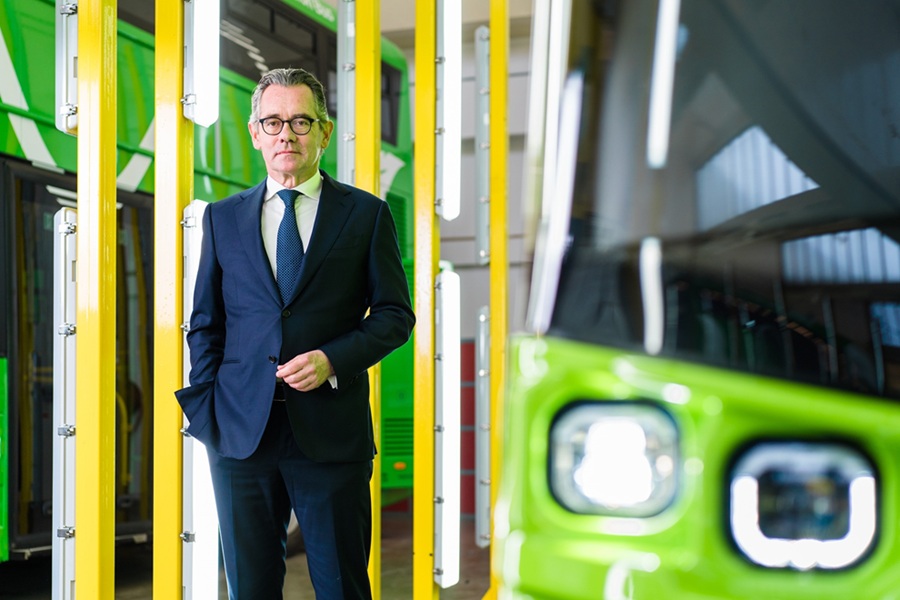
Product platform will give scope for flexibility
Jean-Marc advises that battery-electric may follow hydrogen and diesel on the in-house coach platform, but he believes that hydrogen is better suited to many zero-emission coach applications. In the opening vehicle tilted at scheduled work, a 1,000km range will be delivered with a fuelling time of 10min.
“This will be the first hydrogen coach for the UK market, and it will work,” he continues. “Scheduled services can call for 24/7 utilisation of vehicles, which is why we believe that there will be a market segment for hydrogen.”
Dave adds that flexibility is key to the in-house coach platform thanks to its modular nature. A floor-level luggage area mitigates what can be a difficult point in conventional double-deck coach designs, while ease of access for wheelchair users is a further core part of the opening design brief.
Further scoping on whether when diesel power arrives it will involve a double-deck or standard layout is still to be carried out.

Service and support is a priority for coach market expansion
Jean-Marc notes how AllServiceOne is expanding its roster of mobile service engineers across the UK and Ireland. Many have been recruited recently to give 85 of those specialists. Round-the-clock coverage is part of that landscape. He adds that almost-perfect vehicle availability seen in the builder’s bus products is the target for coach.
And coach is a long-term project for Wrightbus, Dave explains. When service and support provision and hydrogen production and distribution activities under sister businesses within the Bamford Bus Group umbrella are considered, an initial focus on that element as an energy source is easy to understand.
But diesel is also clear within the long-term coach roadmap, with Dave acknowledging that for most retail buyers, zero-emission adoption remains a long way away. Both him and Jean-Marc are keen to stress how when the in-house platform debuts, it will place Wrightbus as the UK’s sole manufacturer of coaches and buses.
Unveiling of that product range is hotly anticipated. The renderings giving a tantalising, if under-wraps for now, indication that it will be the star of the show when it does break cover.

Transdev Blazefield puts first of Keighley eCitaro fleet into services
Transdev Blazefield operation The Keighley Bus Company has started to place a batch of 15 Mercedes-Benz eCitaro battery-electric single-decks into service on route 662 between that town and Bradford.
The fleet of buses represents an investment of £6.6 million. Overall, the project including infrastructure has seen a spend of £4.5 million from Transdev Blazefield and £3 million via a successful bid by the West Yorkshire Combined Authority to the Zero Emission Bus Regional Areas scheme.
Three of the buses are in service thus far. More will follow over coming weeks. The Shuttle eCitaro fleet follows an earlier delivery of the type to Transdev Blazefield business The Harrogate Bus Company, with the latest arrivals also to see route 67 between Keighley and Bradford move to zero-emission.
Transdev Blazefield Managing Director Henri Rohard notes how the new vehicles represent a major upgrade over existing Shuttle buses, “with many new design elements dramatically improving the customer experience.”
He adds that their internal specification has been developed based on customer feedback. Fast wi-fi is included along with USB charging, custom-designed seating in a part-leather, part-moquette trim, and hearing loops and twin full-colour audio-visual information screens to deliver PSV Accessible Information Regulations compliance.
The eCitaro fleet also has a full suite of safety features. Mr Rohard adds that rising installed energy capacity has allowed Transdev Blazefield to take further battery-electric buses. Selection of the eCitaro for Keighley followed evaluation of various types of battery-electric buses on the Shuttle route.
In addition to its two batches of Mercedes-Benz zero-emission buses, Transdev Blazefield has also taken the Citaro Hybrid for Flyer routes serving Leeds Bradford Airport. The operator’s Harrogate operation additionally has a fleet of Alexander Dennis Enviro400EV battery-electric double-deckers for trunk route 36 to Leeds.
[adrotate banner="44"]
Eavesway Travel team-spec T17 Astron is its third Van Hool T
Eavesway Travel of Ashton-in-Makerfield has taken delivery of its third Van Hool T range coach in the form of a T17 Astron super-high tri-axle.
The new arrival is to full sports team and corporate specification and has been fitted out at AD Coach Systems. There are 40 Kiel 1020 seats finished in cream leather arranged around tables and with three-point belts, a centre sunken freshwater toilet, a dash fridge, a radio, DVD and CD player, and a PA system.
AD Coach Systems has added multiple LCD monitors, a large walk-in rear kitchen area with ovens, further fridges, cabinets and running hot and cold water, and much more to enable the coach to fulfil its brief.
Eavesway Managing Director Mike Eaves (pictured, second from left) says that following conversion by AD, the coach was put to work for three weeks as transport for the England Rugby League team during the recent Ashes series against Australia. The visitors were also conveyed by Eavesway, in a VIP-specification Van Hool Altano.
Mr Eaves adds that arrival of the Van Hool T17 Astron “has been well worth the long wait” and he describes it as “a beautiful vehicle for which VDL Bus Group and AD Coach Systems have done a fantastic job.”
For the remainder of the football season, it will be working alongside another operator on a Premier League team transport contract as well as performing VIP and corporate hires for Eavesway’s own client base.
Externally, the coach carries the operator's new distinctive livery and is set off by highly polished alloy wheels, a cherished 75-plate registration mark, and a camera mirror system in place of conventional mirrors. During its Ashes work, the T17 gained special window-mounted vinyls to mark the tournament.
Power comes from a DAF MX-13 engine developing 530bhp coupled to an Allison T525 six-speed fully automatic gearbox.
Joining Mr Eaves for handover of the coach were Eavesway Travel Commercial Manager Aiden Latham (pictured, right), AD Coach Systems Director Nick Weatherby (pictured, second from right) and VDL Bus UK Sales Representative Robert White (pictured, left).
Click on either of the following pictures to enlarge: