
Nottingham City Transport orders 12 Yutong E12s
Nottingham City Transport (NCT) has placed its first order for battery-electric buses in the form of 12 Yutong E12s. They are expected to enter service from Trent Bridge depot in late 2023.
Ordering the Yutong fleet forms the first vehicular procurement in a £34m project that was awarded £15.2m from the Zero Emission Bus Regional Areas (ZEBRA) mechanism and which will facilitate 78 battery-electric single-deckers for Nottingham City Transport.
In addition to the E12s from Pelican Bus and Coach, NCT has appointed Zenobe Energy as charging infrastructure provider. Zenobe will manage necessary construction, the delivery and implementation of charging software, and optimise use of the vehicles. The current infrastructure will allow NCT’s battery-electric fleet to grow in the future.
NCT Head of Engineering Liam O’Brien says that deals have been struck with Pelican and Zenobe after “a rigorous procurement process and operational trials of several electric buses.” Mr O’Brien adds that the Yutong and Zenobe combination was “a clear winner” of that. The E12s will perform a full day’s work on one overnight charge, he says.
The business case for ZEBRA funding submitted by Nottingham City Council in January notes that when all 78 battery-electric buses are delivered, NCT’s single-deck fleet will be entirely zero-emission. That forms part of an aim to have a 100% zero-emission and biogas-powered operation across the board by 2028.
The Nottingham ZEBRA bid is focused only on single-decker buses because the diesel examples in the NCT fleet are currently “nearing the end of their operational life” in the city. Investment in new battery-electric buses is thus “only brought forward slightly” from usual practice. Existing diesel single-deckers – all of which are Euro VI compliant – will be disposed of for continued use elsewhere.
While the 12 battery-electric buses ordered so far are full-length examples, the business case calls for the outstanding 68 to be 33-seaters. An NCT spokesperson says that those vehicles will be tendered for in two batches in 2023.

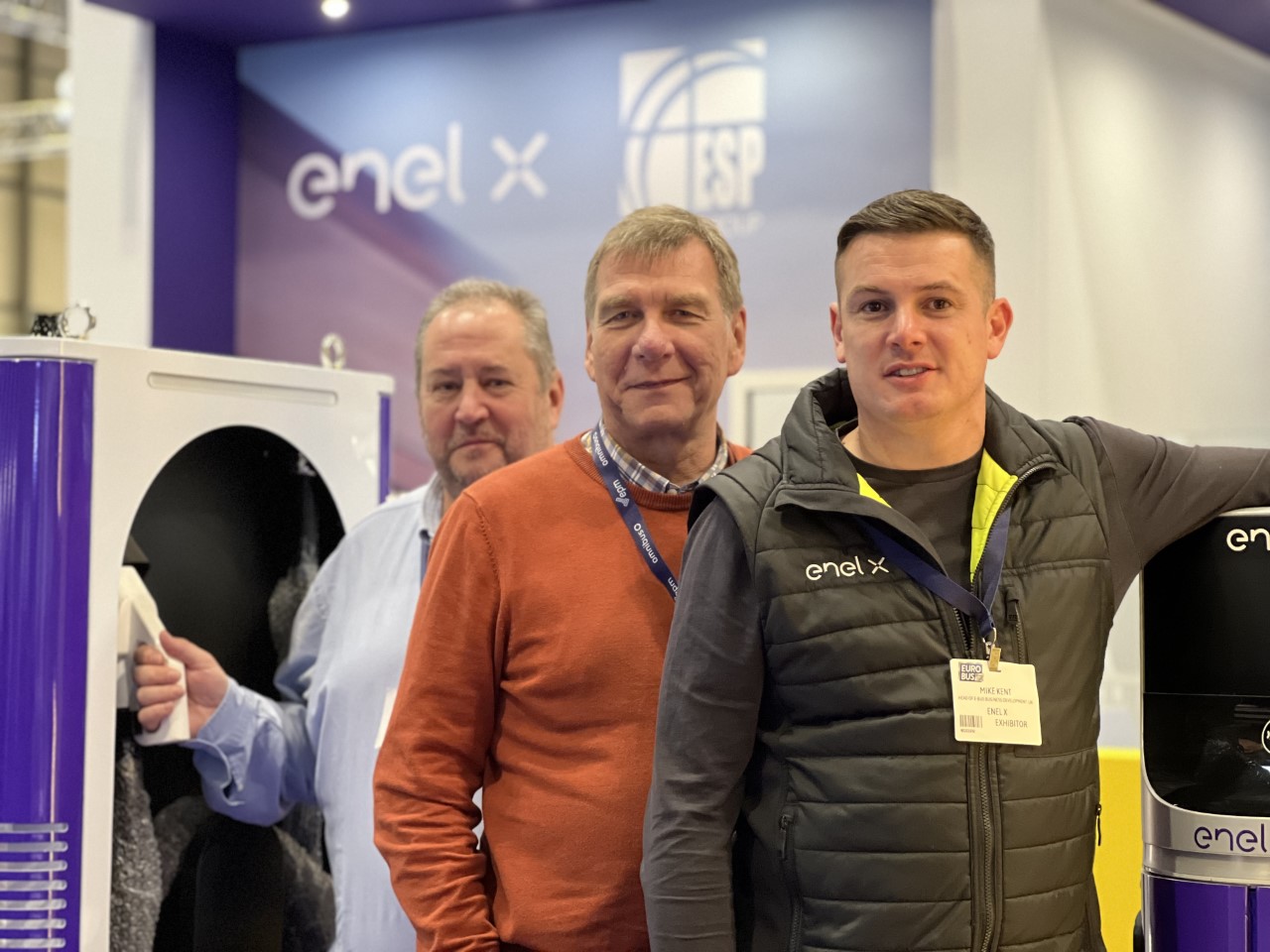
‘Don’t be tripped up by depot electrification’
Michael Kent of Enel X reveals that partnership working is the starting point of success for depot electrification
Enel X and its connection provider, Independent Distribution Network Operator ESP Utilities Group, show partners of Euro Bus Expo and providers of on-site charging for the Zero Emission Zone, were present at their stand to showcase charging products and promote their work in supporting operators with the journey towards depot electrification.
Michael Kent, Sales and Business Development Manager Ebus – UK at Enel X, which is currently working on five electrification projects at different depots across the UK, reveals that the company expects new electric UK bus sales to number around 600 in the year it has been active in the coach and bus sector.
“We’re trying to advise customers on what steps they need to take in order to move from diesel to electric. That’s mainly focused around the synergy between what fleet they’re looking to buy and how that relates to what they need to do at their existing depots,” explains Mr Kent. “We find that new entrants to zero-emission purchasing need their hand holding in terms of the steps they need to take,”
Mr Kent says many operators are buying buses without checking that they have an available connection. The other thing it sees is ambitious net-zero plans, though more work is needed on a sustainability and depot electrification basis. Enel X meets this challenge through phased introduction of depot electrification.
“We try and sit down with a customer – and this helps with the grid connection – and ask where it is looking to get its depot to, and when, in terms of 100% electrification. In some cases, we look at first, second and third phase. Not everyone is thinking like that. That may trip them up in years to come. The biggest challenge in depots is the the space element.”
According to Mr Kent, a full electrification vision, if rushed, can see the operator potentially losing valuable vehicle space. “It’s important that partners that we work with are flexible, and agile, to offer various types of solutions,” he adds. “In this sector, you’ve got to do it with partnerships. We’re a different part of the chain. That’s why we’re here together, with ESP, to tell the story – it starts here.”
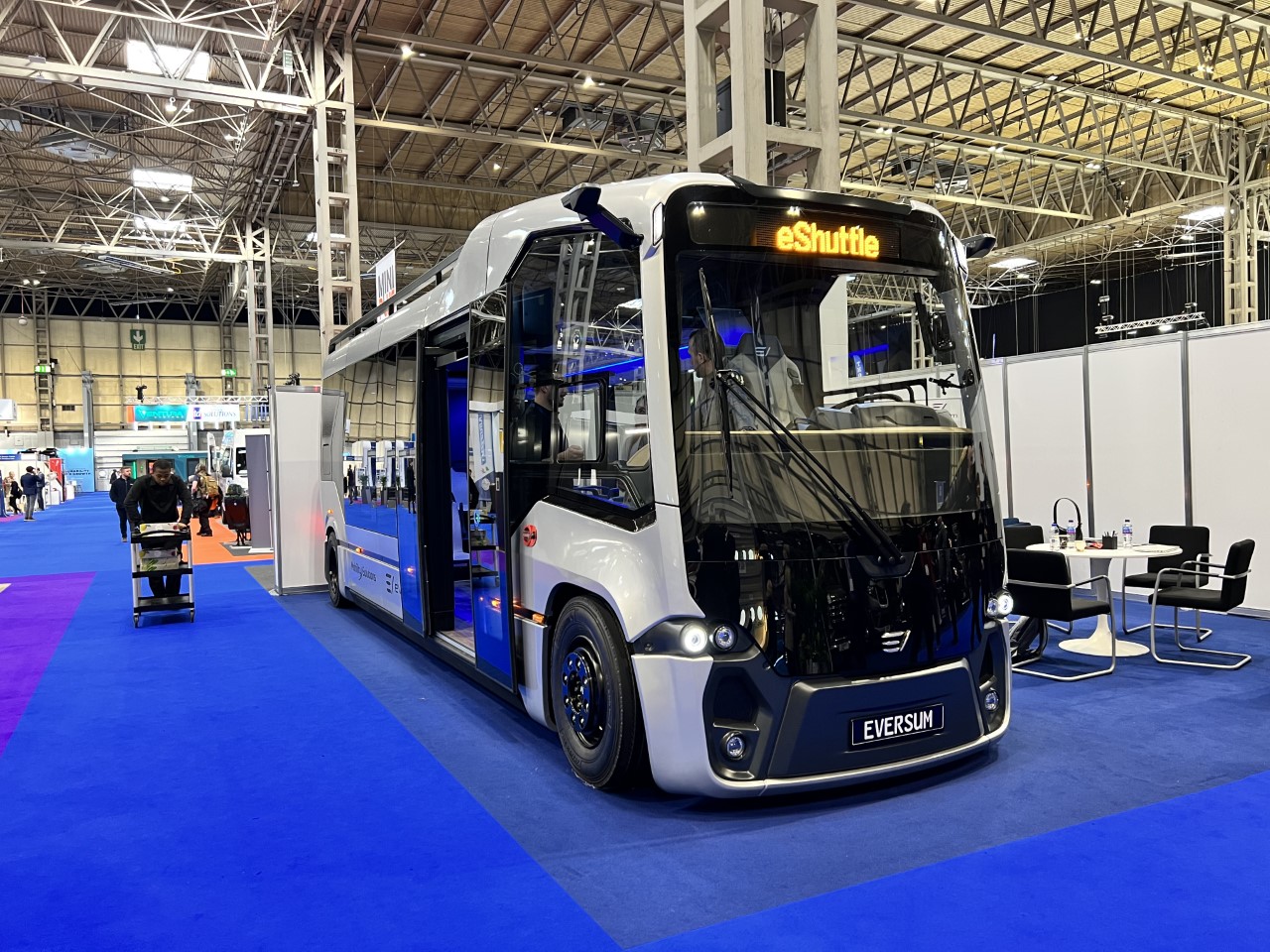
eVersum demonstrates autonomous-ready shuttle bus
e-Shuttle autonomous-ready electric shuttle bus makes its UK debut at Euro Bus Expo
Austrian EV manufacturer eVersum was present at Euro Bus Expo to showcase the e-Shuttle, a battery-electric shuttle bus for inner-city and airport use that can be specified in an autonomous-ready version, up to level four. Designed in-house, with an integrated electric drive axle with four-stage automatic gearbox, the e-Shuttle comes in three lengths of 5.4m, 6.9m and 8.4m, seating between 30-55 people. A modular design means the manufacturer is flexible with the door positioning and length.
Battery chemistry choices include lithium titanate oxide (LTO) and lithium, nickel and manganese (Li-Ion NMC). A low-floor design throughout, achieved through specially developed 13.5cm high battery packs placed in the floor, both gives the vehicle low centre of gravity and means interiors can be optimised for multiple duties. Battery capacity ranges from 42-84 kW/h in smaller models to 118-236kW/h in larger sizes; charging is done via a 22kwon-board charger or via pantograph-style options. Batteries are supplied by Microvast, and eVersum says it is looking at fuel cell range extender options up to 22kW.
It is the first time the bus has been presented in the UK, shortly after its exposure at an exhibition in Germany. “Historically we have had good experiences here of quantity and quality of interactions,” says Managing Partner Pete Speck, who capitalises on the fact the bus is “e-born”, with every component optimised for zero-emission application.
“It is a European-built vehicle. If you look at it, there’s nothing out there like this. It’s e-born, it’ s consequently built.”
Other features include a digital mirror-replacement system, audio-visual passenger information systems, and wheelchair ramp integrated into the vehicle floor. “We try to cater to whatever the customer needs,” adds Mr Speck. “As a market, if you have a route somewhere where you need something smaller, or where you might want to test autonomous driving down the road, this is the perfect fit.”