
Liverpool hydrogen buses to return after green fuel solution found
The 20 Alexander Dennis Enviro400FCEV hydrogen fuel cell-electric double-decker buses owned by the Liverpool City Region Combined Authority (LCRCA) are expected to see more intensive use soon after a supply of green hydrogen was secured.
Those buses debuted in 2022, with service entry from 2023. They are split equally across Arriva Merseyside and Stagecoach Merseyside, Cheshire and South Lancashire for use on the jointly operated 10A route between Liverpool and St Helens.
While those with Arriva have seen sporadic service, the 10 with Stagecoach are yet to carry passengers. LCRCA says that all 20 buses are currently out of use to undergo a battery refit at no cost to the Combined Authority.
That work will “improve reliability and performance.” It is anticipated that the hydrogen fleet “will be able to re-enter service in the coming weeks” on the 10A and adjacent 10 service. The latter route is operated exclusively by Arriva. At launch it was stated that each bus has a 30kWh battery.
On fuelling, a spokesperson adds: “Following delays due to global hydrogen supply issues, the Combined Authority has now secured a supply of green hydrogen fuel, which will allow the buses to be introduced into service following a period of driver training.” Deployment of the high-specification Enviro400FCEVs has been beset by fuelling difficulties since delivery.
While similar problems have been experienced by hydrogen buses elsewhere in the UK, LCRCA has underlined that the 20 Enviro400FCEV double-deckers have a long-term future alongside battery-electrics.
Questions over the status of the hydrogen buses arose after papers published ahead of a meeting of the Combined Authority on 19 July said that the 10A is to receive an allocation of £28.2 million from the conurbation’s City Region Sustainable Transport Settlement (CRSTS) towards outputs including the purchase of battery-electric buses for that route.
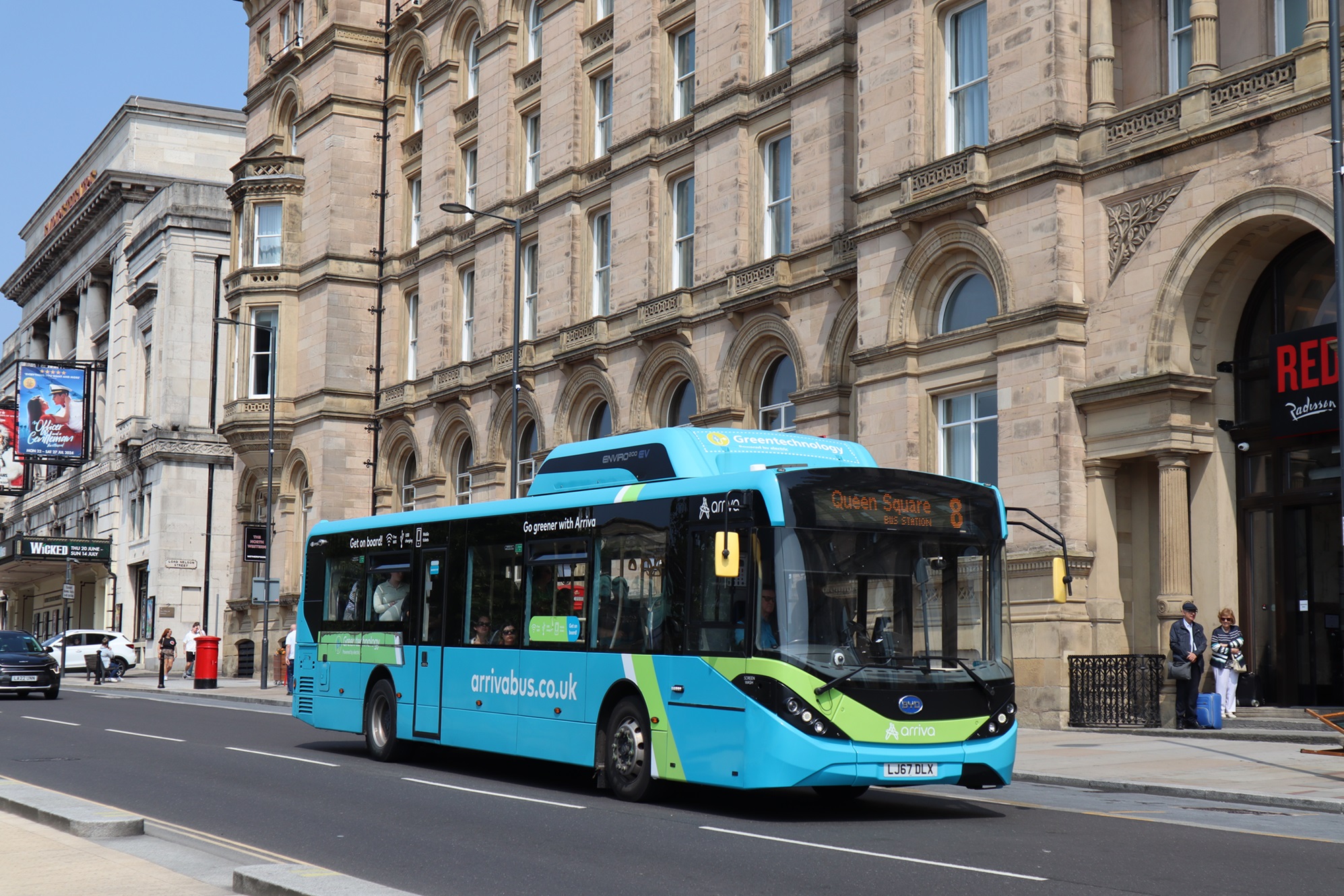
Those papers note that three services – 10A, 53 and 86 – are slated to receive CRSTS money to procure battery-electric vehicles and what is described as “a depot… to serve each corridor.”
When combined with £7.2 million for bus priority infrastructure and £32.7 million for a new bus interchange in St Helens, the CRSTS draw-down will be over £108 million. Approval was given by LCRCA members at the 19 July meeting.
Purchase of battery-electric buses and depots forms part of the Combined Authority’s Bus Decarbonisation Programme and is “consistent with the bus franchising proposals approved by the Combined Authority in October 2023,” the papers add.
A need for the construction or acquisition of up to eight bus depots by LCRCA is anticipated as part of its operating centre strategy for franchising to maximise competition for contracts. Land and sites for those have already been identified.
However, a spokesperson advises that while battery-electric buses will be purchased with CRSTS money, it is understood that they may not in fact be sourced for the 10/10A corridor.
“The route will, though, receive investment, particularly with respect to measures designed to improve punctuality and reliability,” they add.
Despite that, during the meeting of 19 July, Mayor Steve Rotheram noted that the battery-electric buses to be procured are for services including the 10A. The LCRCA spokesperson adds that while the hydrogen buses will work alongside battery-electrics in wider network decarbonisation, deployment of vehicles to routes will be “kept under regular review.”
In his manifesto ahead of re-election as Mayor of the Liverpool City Region in May, Mr Rotheram pledged to fully decarbonise the conurbation’s bus fleet by 2035.

Irizar UK and Dawsongroup partnership commences coach supply
Irizar UK and Dawsongroup Bus and Coach have embarked on a relationship that will see the dealership and the rental, hire and leasing specialist jointly supply integral coaches from the Spanish manufacturer.
Ely-based Greys and Woods Travel of Bognor Regis are the first operators to benefit from the agreement, with each taking an i6 integral. Irizar UK Sales Director Julie Hartley describes the approach as “a triangular relationship” between the two suppliers and the customer.
Four further i6 integral coaches will follow under the partnership, with two due later this year and the others late in 2025. Mrs Hartley notes that while the order with Irizar UK is placed by Dawsongroup, scope is in play to engage flexibly with the ultimate customer in agreeing a specification, and that the two suppliers’ sales teams work together to deliver it.
While the i6 integral makes up initial procurement via the collaboration, Mrs Hartley does not rule out expanding it to other members of the Irizar integral coach range should that suit all parties.
“Irizar has always prided itself on adapting vehicles to suit the customer and Dawsongroup recognises that,” she continues. “With more coaches coming in the future, we can work proactively with Dawsongroup to place them in a timely manner to be able to continue this approach.”
Dawsongroup Bus and Coach Sales Director Fraser Innes says that the supplier is “delighted” to be working with Irizar UK on the supply of the Greys and Woods Travel coaches. He notes that both vehicles have been configured to suit the customers’ needs, and that the Woods coach represents “a rental solution that matched the needs of [Woods’] business.”
Each i6 integral supplied under the partnership is a restyled variant. That work was done by Irizar some months ago and is described as a minor refresh to bring the long-established i6 visually into line with the i6S and i8 models and the restyled i4.
Change is limited to the front and the rear of the i6. Mrs Hartley adds that the evergreen model is still in demand from some buyers. It also retains popularity in southern European markets.
Further Yutong TC9 midi joins the Mainline Coaches fleet
Mainline Coaches of Gilfach Goch has added another Yutong TC9 to its fleet, supplied by Pelican Bus and Coach.
It follows multiple previous examples of the midi to the Rhondda Cynon Taf operator and is finished in the business’s customary metallic green livery.
34 seats in a black and orange, half-leather trim configuration are fitted along with a toilet, while PSVAR compliance is also part of the package.
Mainline Coaches Managing Director Chris Mainwaring says that the decision to purchase a further Yutong was based on excellent service from previous TC9s, along with the aftersales support from Pelican.
Area Sales Manager Lee McMahon handled the sale for the dealership. Power is from the Cummins B6.7 engine developing 320bhp coupled to a ZF EcoLife automatic gearbox.
[adrotate banner="44"]