
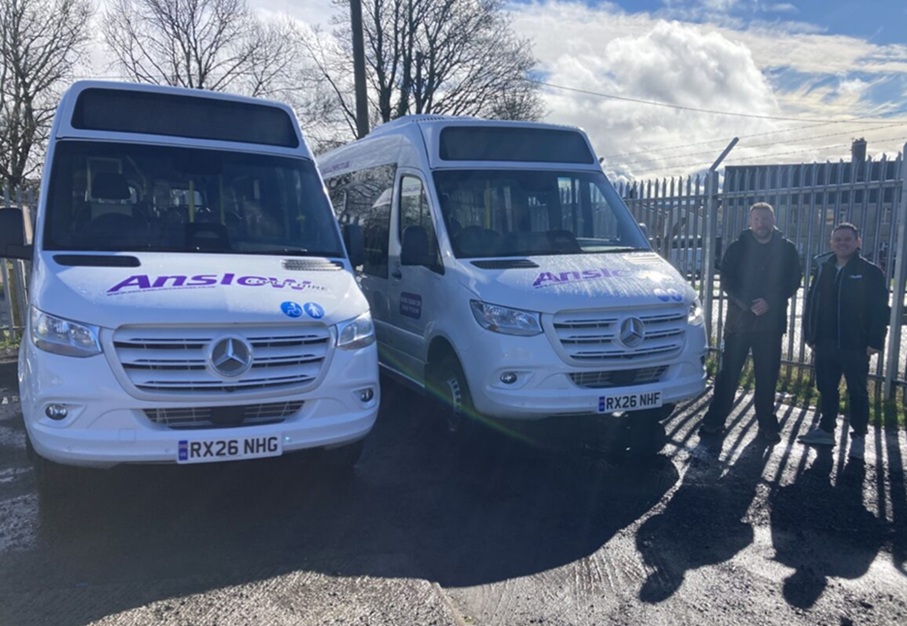
EVM hits 500 units for Cityline with Phil Anslow Coaches delivery
EVM has completed 500 deliveries of its Cityline low-entry minibus built on the Mercedes-Benz Sprinter with the supply of numbers 499 and 500 to Pontypool operator Phil Anslow Coaches.
They are diesel models, but the accessible product is also available as the battery-electric e-Cityline. It is a compact vehicle that in diesel format has a front engine and capacity for up to 22 passengers.
Phil Anslow Coaches has previously purchased the Cityline and now has four in its fleet, with director Chris Anslow (pictured, left) noting that he expects more will follow. Mr Anslow has credited EVM Area Sales Manager Stephen Haywood (pictured, right) for his approach to the transaction and to communication throughout the sale process.
The South Wales operator is to use the new Citylines on routes that encounter congested and narrow roads, where their compact size will be beneficial.
EVM says that the 500 sales figure for the Cityline platform takes account of the UK and Irish markets. Those vehicles have been supplied to public and private sector buyers. The battery-electric e-Cityline “is rising in popularity,” it adds.
A smaller number of zero-emission high-floor minicoaches on the Sprinter platform using the same driveline have also been sold.
[adrotate banner="44"]

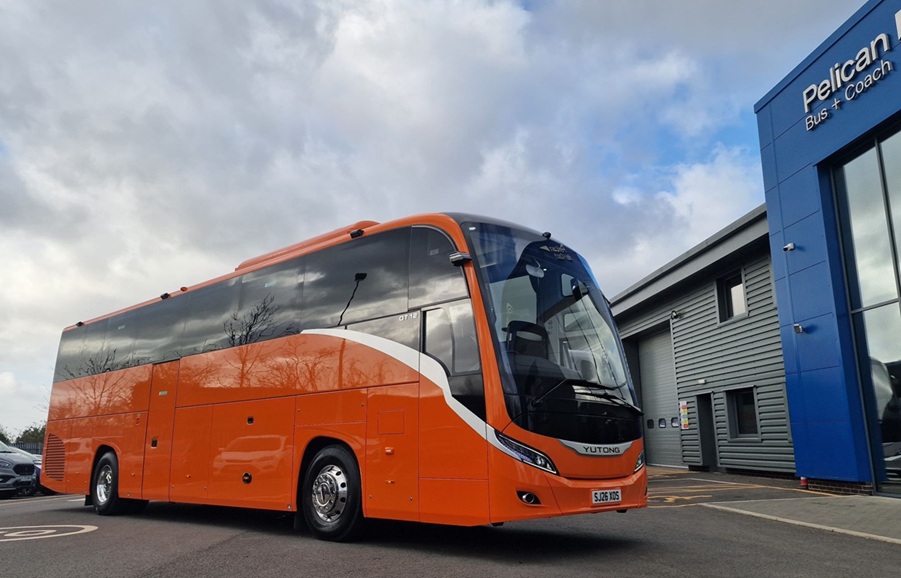
The Hairy Coo introduces a CMS-equipped Yutong GT12 coach
The Hairy Coo has welcomed a further Yutong GT12 to its fleet, supplied by Pelican Bus and Coach.
It is a PSVAR ready example and has been finished in the Edinburgh operator’s orange shade by Yutong at its factory. Arrival of the coach follows two previous GT12s that were delivered in white.
53 seats in an orange and black scheme are fitted along with the standard GT12 items of USB and 240-volt charging points, a centre sunken toilet, and a 360-degree bird’s eye camera setup.
In addition, the operator has selected the optional camera monitoring system in place of conventional mirrors. Pelican introduced that fitment to the GT12 around a year ago.
UK and Ireland Coach and Truck Sales Manager Simon Collins says: “This latest vehicle supplied to The Hairy Coo showcases everything that makes the GT12 such a popular choice in today’s coach market, from its new refined interior and advanced driver assistance systems to its outstanding build quality.”
The Hairy Coo also operates the smaller Yutong TC9. It has two of the latest generation of that midicoach on order as part of a large debut batch of the overhauled model due for delivery to Pelican.
[adrotate banner="44"]
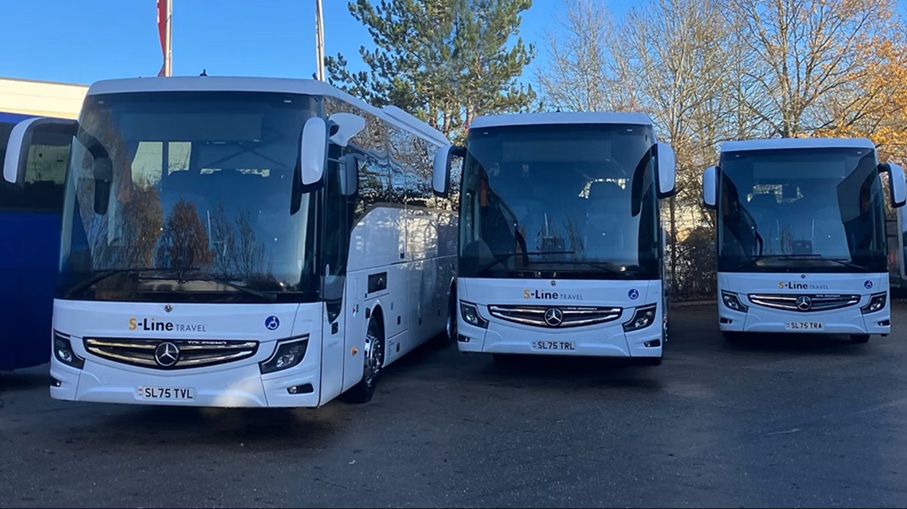
New Tourismo trio arrive with Blackburn operator S-Line Travel
S-Line Travel of Blackburn recently took delivery of three Mercedes-Benz Tourismo coaches, supplied by Daimler Buses UK.
They are 12-metre, two-axle examples that have been built to what the dealership says is a bespoke specification. That includes 53 seats in Travel Star Eco upholstery and with drop-down tables and footrests.
USB charging is part of the package along with twin 21.5-inch LCD displays. The coaches are PSVAR compliant, while the driver benefits from a leather-trimmed steering wheel, a seat that has swivel functionality, and a reversing camera.
General Safety Regulation compliance is included along with safety programmes Active Brake Assist 6, Sideguard Assist 2, and Traffic Sign Assist. Each of the coaches comes with a cherished registration mark.
Power is delivered by the OM 470 engine developing 422bhp coupled to a ZF EcoLife six-speed automatic gearbox. The new Tourismos follow previous examples of the model into the S-Line Travel fleet.
[adrotate banner="44"]