
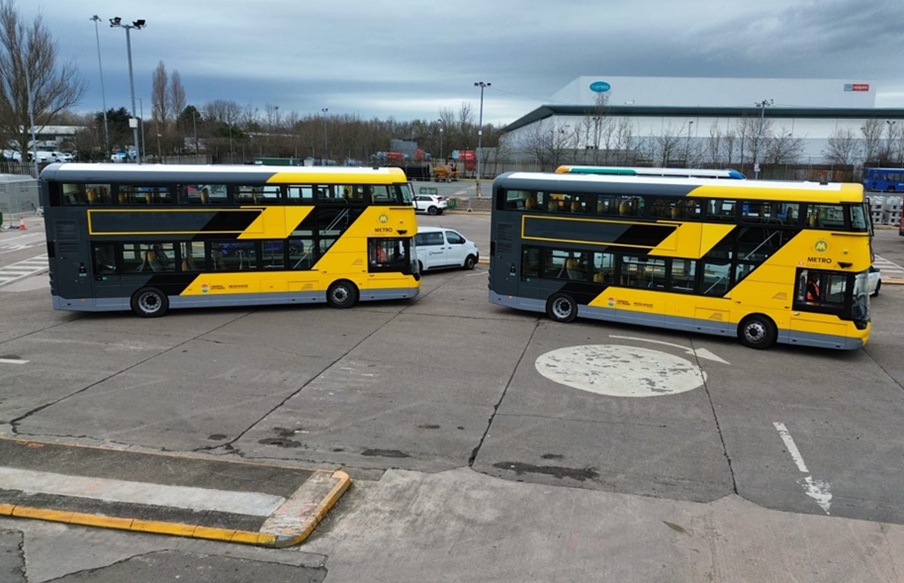
First Liverpool City Region CA-owned battery-electric buses arrive
Battery-electric double-deck buses will enter squadron service in the Liverpool City Region soon after the first of more than 100 of those vehicles were delivered on 25 February.
Driver training will start shortly ahead of the vehicles commencing revenue service in the coming weeks and months, the Liverpool City Region Combined Authority (LCRCA) says. It has bought the buses, which are Alexander Dennis Enviro400EV and Wrightbus StreetDeck Electroliner types.
The first StreetDeck Electroliners have been pictured at the Stagecoach Merseyside depot at Gillmoss in north Liverpool, where installation of charging infrastructure for battery-electric buses is underway. They have glazed staircases and camera monitoring systems.
Construction of both the StreetDeck Electroliners and the Enviro400EVs began some time ago. An Enviro400EV was present at a recent Alexander Dennis event with Stagecoach legal lettering and a 25-plate registration mark.
Although hydrogen fuel cell-electric double-decks have operated in the Liverpool City Region, the Enviro400EVs and StreetDeck Electroliners will be the first battery-electric examples to join fleets based there. The 20 hydrogen buses will be converted to battery-electric by original builder Alexander Dennis.
Arrival of the opening battery-electrics precedes the start of franchised bus services in the region. The first contracts for that network were recently awarded ahead of mobilisation in the second half of 2026, although Gillmoss is not part of that first tranche.
LCRCA says it will invest “hundreds of millions of pounds” in the area’s bus network over coming years. Mayor Steve Rotheram aspires for the region to be net-zero carbon by 2035 and zero-emission buses are an important part of that, he notes.
Papers from an LCRCA Overview and Scrutiny Committee meeting on 22 October 2025 noted that 108 battery-electric buses were then on order for delivery in early 2026.
The Combined Authority was awarded £9.4 million from the second round of the Zero Emission Bus Regional Areas scheme towards 58 of those vehicles for operation from what is currently the Stagecoach depot in Gillmoss. £26.1 million of City Region Sustainable Transport Settlement money was later put to 50 more such buses.
[adrotate banner="44"]

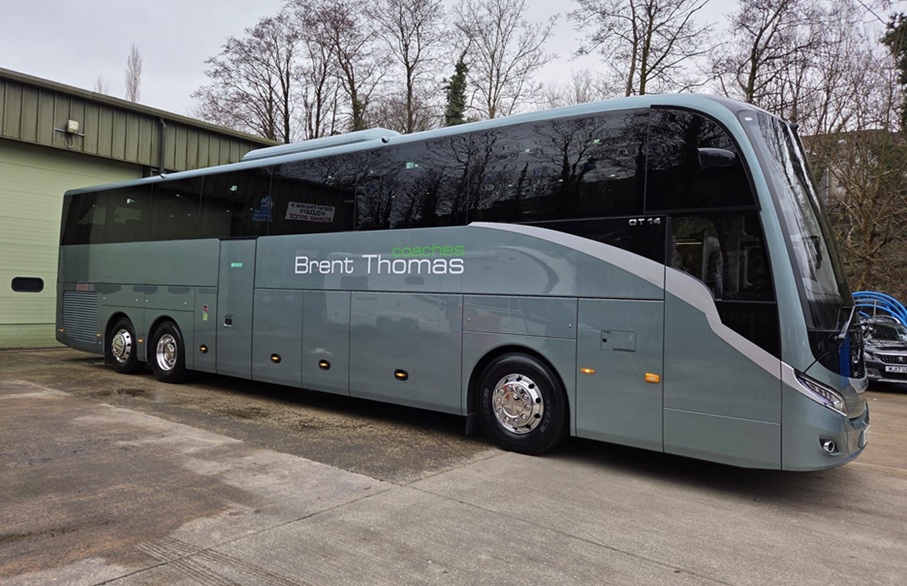
Brent Thomas Coaches enters the Yutong fold with a new GT14
Brent Thomas Coaches of Tonypandy has taken delivery of its first vehicle from the Yutong stable in the form of a 61-seat GT14 tri-axle, supplied by Pelican Bus and Coach.
It is completed in the operator’s customary metallic livery shade, which was applied after arrival in the UK. A 26-plate registration mark is affixed ready for service entry in March.
The GT14 comes with a host of interior fitments as standard. Those include 240-volt and USB-A and USB-C power sockets. PSVAR compliance has been specified, with a passenger lift above the drive axle and silver LED destination displays.
Other configuration elements include a camera monitoring system and 360-degree bird’s eye view. Power is from a DAF MX-13 engine developing 483bhp coupled to a ZF EcoLife six-speed automatic gearbox.
Pelican UK and Ireland Coach and Truck Sales Manager Simon Collins has thanked Brent Thomas Coaches for its conquest business and highlighted how the GT14 fits easily into a fleet that prioritises premium comfort and safety on tri-axle touring vehicles.
[adrotate banner="44"]
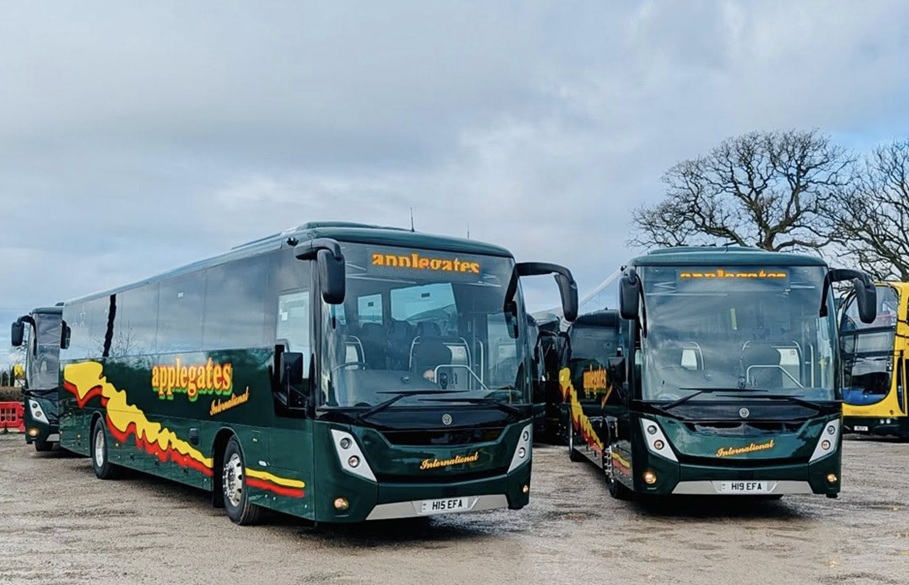
Applegates Coaches takes its MOBIpeople Explorer fleet to five
Applegates Coaches of Berkeley has received two Scania K320NI additions with MOBIpeople Explorer bodywork, supplied by BASE Coach Sales.
They take to five the number of Explorers in the Gloucestershire fleet, with the first delivered in 2023. The newcomers include 74 Prime Buckingham seats and PSVAR compliance on a two-axle chassis.
Hidral Gobel has supplied the passenger lifts and Hanover the silver LED destination displays. Drive is taken through the ZF EcoLife six-speed automatic gearbox.
Applegates Coaches Managing Director Ceri Taylor describes the Explorer as a solid workhorse, with 74 seats giving a benefit over more typical 70-passenger capacities in its class. As a result, the business has been able to reduce its double-deck coach fleet.
Mr Taylor adds that the centre nearside double door is beneficial for loading and unloading, while the 12m length aids manoeuvrability. Accurate projections of delivery times and strong aftersales support by BASE are also acknowledged.
“As always, we are impressed with the build quality,” he continues. “Smooth, no rattles, simple to use, and they go straight on the road with very few issues in the first year. They are a pleasure to have on the fleet list.”
[adrotate banner="44"]