
Pelican Bus and Coach further grew the Yutong coach range here in late 2025 with the GT14 diesel tri-axle. It quickly gained traction; an opening batch of 15 were sold off-plan, and more are due in May and August.
The GT14 is effectively an upscaled version of the successful GT12 two-axle. It also sits alongside the battery-electric GTe14. The latter has the same envelope as the GT14, but some elements of it differ, such as the cab area and the approach to accessibility.
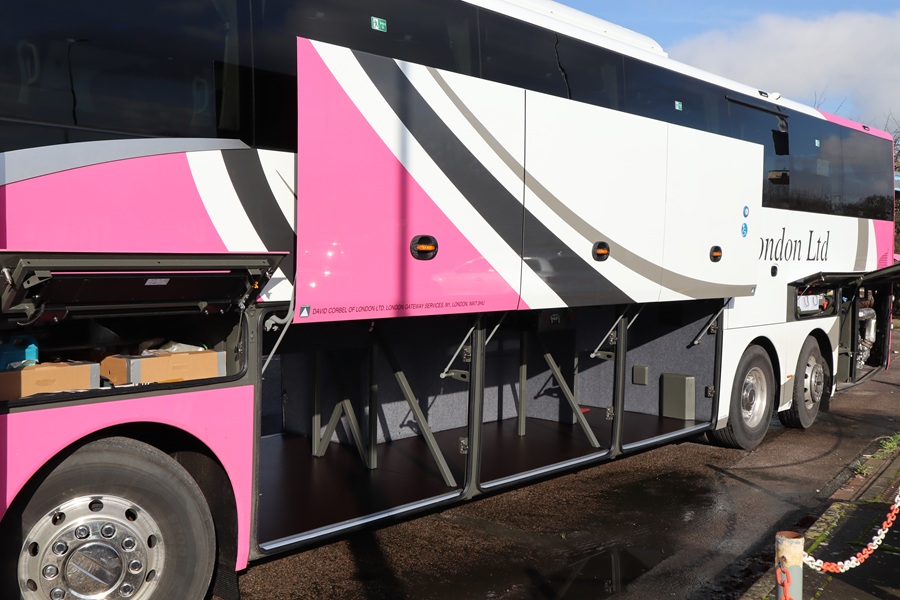
Buyers of the GT14 thus far are predominantly small operators. The model promises excellent versatility in the tri-axle field. Its high floor gives good luggage space and PSVAR compliance comes without compromising that area. The driveline of a DAF MX-13 engine and a ZF EcoLife gearbox leaves no doubt around capabilities in testing use cases while retaining a ‘point and shoot’ approach.
Corbel Coaches is an early taker. It has two GT14s. Managing Director Robert Whelan notes how the London operator saw good results from earlier GT12s, although he is not tied to one builder and favours a mixed fleet. Robert adds that earlier examination of a GTe14 piqued his interest in a tri-axle Yutong. “I told Pelican that when it did a diesel, I would take two,” he explains.
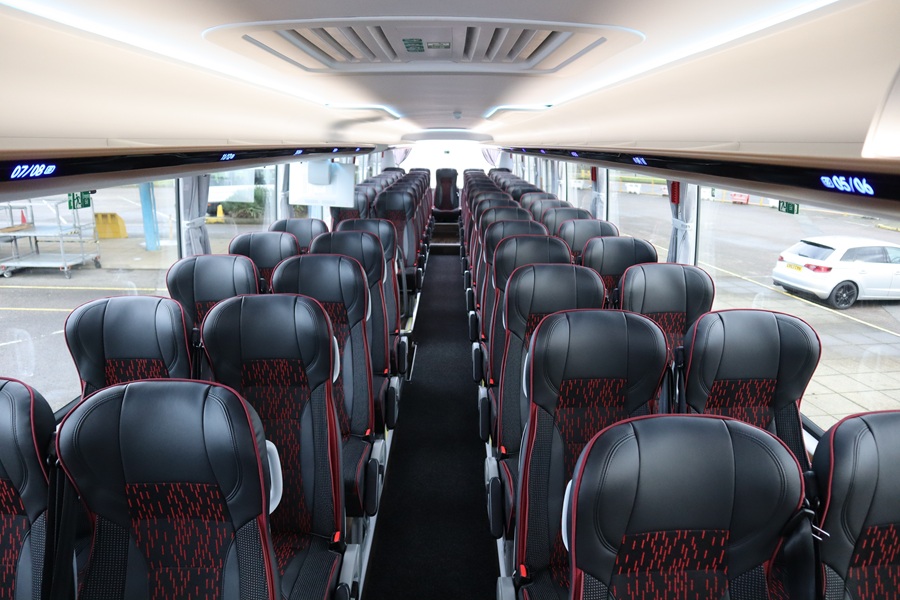
Corbel’s GT14s are used on a variety of work, although the operator broadly stays close to home. Tri-axles were favoured in the recent vehicle procurement for two reasons. Capacity is important; while 45 passengers can fit on a 61-seater, the reverse is not the case.
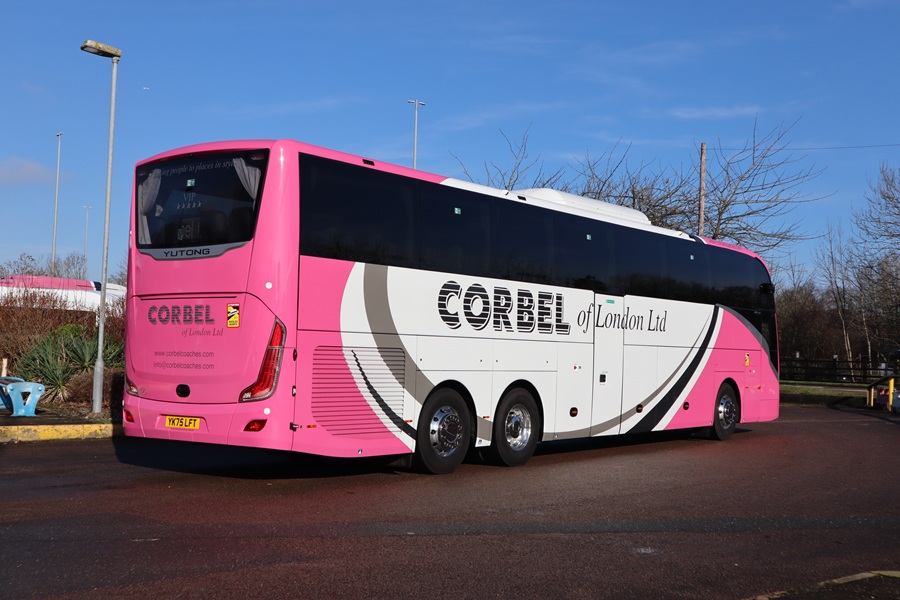
Manoeuvrability is another strength. The operator once trialled 15m tri-axles that proved unwieldy, but a 14m footprint with a steering rear axle is ideal. Of the pair of GT14s, one is in the Wembley City Coaches fleet, and the other is with Corbel in its distinctive pink-based livery. Robert kindly made the latter available for a routeone Test Drive.
Yutong GT14 makes a striking first impression
The GT14 is a striking coach at 3.84m high and with the trademark GT range headlights. There are no mirrors; instead, a camera monitoring system (CMS) is fitted. Alongside it is a 360-degree ‘bird’s eye’ set-up that displays via the dash.
The lenses that feed to it sit close to Corbel’s favour of video for telematics and monitoring. Because of the number of cameras that the coach has as standard, the operator needed to add only three more to deliver what it wanted in that respect. Usually, that number is nine.
Twin fuel fillers are over the front axle and AdBlue goes in at the nearside rear, where a Spheros coolant pre-heater is mounted along with the exhaust. On the offside behind the bogie is the radiator. It has 10 electrically-powered small fans rather than a single hydraulically driven unit to improve efficiency.
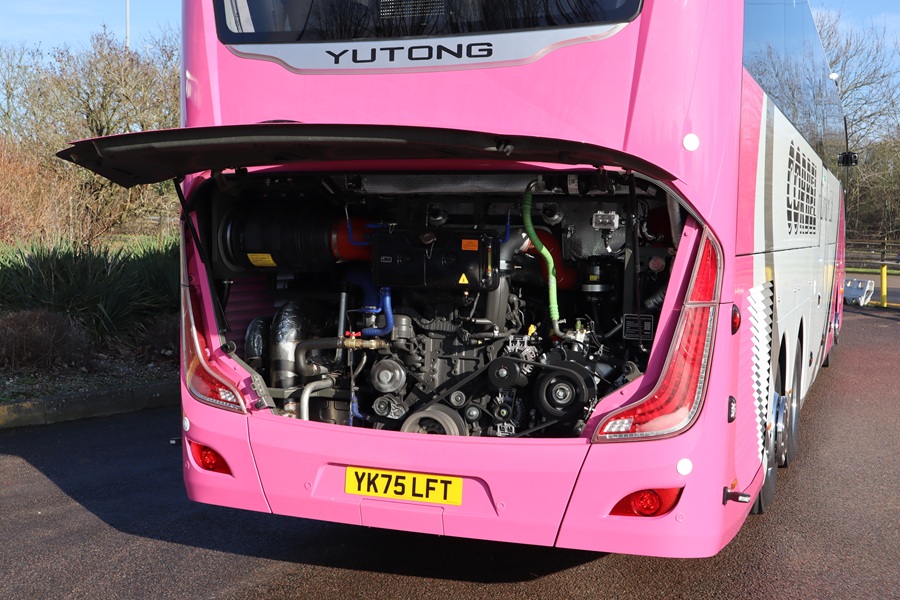
The MX-13 develops 483bhp and 2,500Nm of torque. Corbel Coaches has added some marker lights at the rear; Pelican expects to fit those as standard on future builds. Such coaches will also come from the factory with central locking.
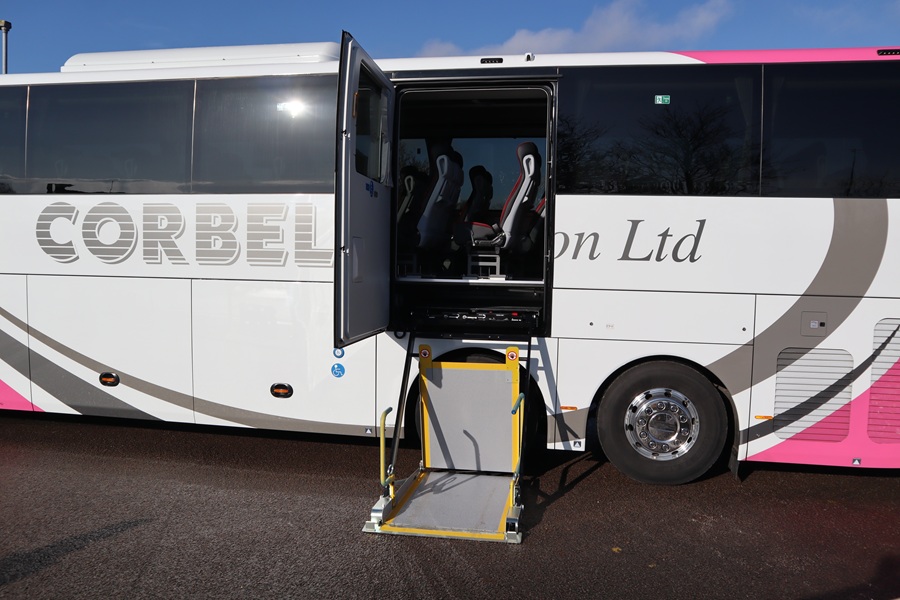
As part of their PSVAR compliance, both of the GT14s have a Hidral Gobel 350kg passenger lift in a ski locker over the drive axle. Yutong does preparatory work at the factory, but the platform is installed here. Also going in at Castleford are destination displays supplied by McKenna Brothers.
All GT14s ordered by Pelican are PSVAR ready, although the additional door can be deleted if the customer commits early enough in the build process. As with other Yutong coaches, the GT14 is pre-wired to permit the necessary equipment for next-stop announcements and PSV Accessible Information Regulations compliance.
Marked unladen weight is 15,600kg. Gross is 24,500kg. Ride is on 295/80 R22.5 tyres.
Newcomer is well-equipped inside as standard
Both the crew and passengers are well looked after. Pelican previously highlighted the GT14’s lighting set-up and what is termed a contribution to a business class-esque experience. It is made up of strips within a lip between the luggage racks and the ceiling, other LEDs in the undersides of the racks, and downlighting in the windowsills.
A quirk of the GT14 is that it has two positions for the continental door depending on the seating capacity specified, which is 57 or 61. One variant thus cannot be converted to the other. The pair for Corbel Coaches have 61 positions and a centre sunken toilet.
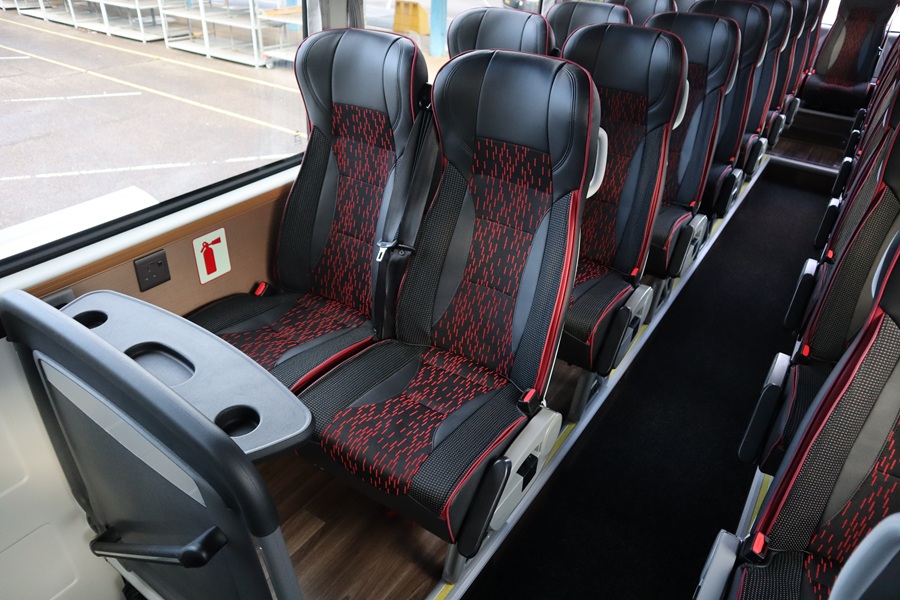
Yutong’s own seats are fitted. They are trimmed in fabric and synthetic leather with red piping and inserts. Standard fittings include drop-down tables, lateral adjustment and footrests. USB-A and USB-C charging points are largely within seat backs, although not for the three pairs that are removable to make space for a wheelchair user. There, USBs are within the side walls. 240-volt three-pin sockets are at every other row.
The difference in continental door position depending on capacity is to equalise legroom. Sitting at a variety of rows on each side and at the front and the rear showed that someone over 6ft tall can do so without touching the seat in front.
Yutong does not fit a DVD player, but the head unit has a USB input for video. Twin monitors are present. On a cool day the heating system proved to be highly effective; the air-conditioning unit is complemented by perimeter radiators, with the cab controller having an automatic setting or scope to fine-tune fan speed and such.
Technology abounds in Yutong GT14 cab area
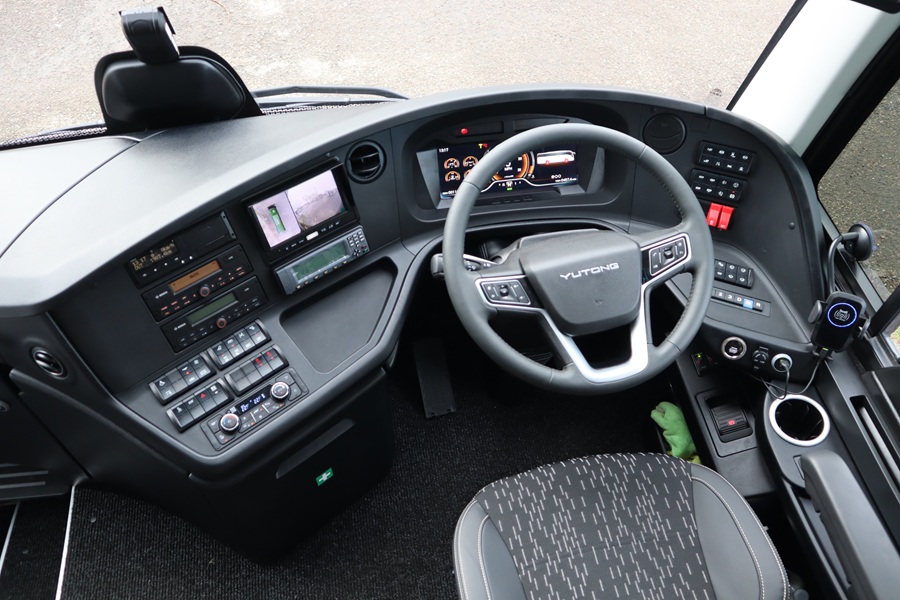
In the cab is a high-specification driver’s seat. It has air-conditioning and heating; future coaches will also have a massage facility. The courier naturally has a more basic position, but below the in-dash fridge they get a row of buttons for the nearside windscreen blind, a reading light, to lock the toilet, and to activate the boiler when fitted.
Within the door is a péage opening, while the signalling window is powered and heated. The section of glass ahead of it is double-tinted. It would perhaps be beneficial for that to be the same shade as other cab glazing.
A digital dash binnacle is configured with a large tachometer is in the centre and a road speed indication within that, although what is shown on the display can be customised by the user. The steering wheel has reasonable reach and rake, functionality that is activated by one of the many rocker switches to both sides of it. Stalks are very solid, with the gearbox retarder activated by that on the right.
Like the GT12, an electric handbrake is used. It is below the signalling window. To the left of the driver are units such as the tachograph, climate control module and others; a tray for small items is also there and additional storage is to the right of the seat. The overall cab impression is good and the GT14 will hold its own in that respect against any competitor.
DAF’s big MX-13 engine delivers the goods
The MX-13 leaves no coach short of poke, and so it proves in the GT14. Unusually, the model has a ‘sport’ rocker switch on the dash, which influences gearshift points. It can be disconnected if the buyer requires.
When not in sport mode, the coach adopts a more economy-focused approach. That sees upshifts at around 1,300rpm, but the engine produces peak torque from 900rpm and so driveability is not impacted. In top gear at 50mph, it is happy at 1,000rpm. At the limited speed, it shows 1,250rpm.
Although the test coach is still new, fuel consumption so far is good. On mixed work, around 11mpg has been returned, according to telematics. On a longer trip, 14mpg was seen.
Other driving aspects are positive, although the door has limited glazing and hence care is needed at junctions or when manoeuvring. The CMS feed is clear; lines to mark axle positions and the extreme rear of the coach illuminate when the indicators are applied and are useful, while the 360-degree display is a boon. In addition, the same unit creates an ‘up and over’ view from beyond the rear to further aid visibility.
Roadholding is a particular strength. The GT14 sits squat and handles potholes and imperfections well. Its steered rear axle proves Robert’s comments on manoeuvrability, while the engine is imperceptible from the cab even under full throttle. With no mirror arms the traditional whistling at higher speeds is absent. All in all, the coach is a highly pleasant machine to pilot.
Sales strong already, dealership Pelican reports
In the longer-term Pelican sees a market for up to 35 units per year in the diesel tri-axle field. The GT14 has already settled in well with buyers. It continues development of the Yutong coach range that began with the GT12 and will shortly see an updated TC9 midi join.
Of the GT14 batch due in May, Pelican had one unsold at the time of writing, showing how the type has quickly been accepted. It is unquestionably a strong competitor. Area Sales Manager Steve O’Neill notes scope for customisation by third parties and thus an avenue exists for the model to meet team coach needs alongside tours, private hire and scheduled work.
Underfloor luggage space is extensive, the passenger and driver experiences are good, and Robert notes a responsiveness from both Pelican and Yutong in aftersales and taking customer feedback. He does not rule out more GT14s for Corbel Coaches in the future – indication indeed that the first have been well received.
Facts and figures – Yutong GT14
Engine: 12.9-litre, six-cylinder DAF MX-13
Power: 355kW (483bhp) @1,600rpm
Torque: 2,500Nm (1,844 lb ft) @900-1,125rpm
Emissions: Euro VI using EGR and SCR
Gearbox: ZF EcoLife six-speed automatic
Tyres: 295/80 R22.5
Length: 13.97m
Height: 3.84m
Width: 2.55m
Wheelbase (axles 1-2): 6.69m
Gross weight: 24,500kg
Unladen weight: 15,600kg
Fuel economy: Up to 14mpg.